
Posted by Spycor Building on Mar 17th 2026
In the 2026 high-performance building landscape, "good enough" house wrap is no longer an option. Between unpredictable labor schedules and the push for Net-Zero energy standards, the building envelope is under more pressure than ever.
When projects stall and the exterior remains exposed to the elements for months, traditional mechanically fastened wraps often fail. This is why professionals are shifting toward the self adhered air barrier membrane as the new gold standard. But is DELTA®-STRATUS SA truly the best air barrier for exterior walls?
This review breaks down the technical specs, the job-site reality, and the bottom-line ROI for professionals looking for a reliable peel and stick house wrap.
What is DELTA®-STRATUS SA?
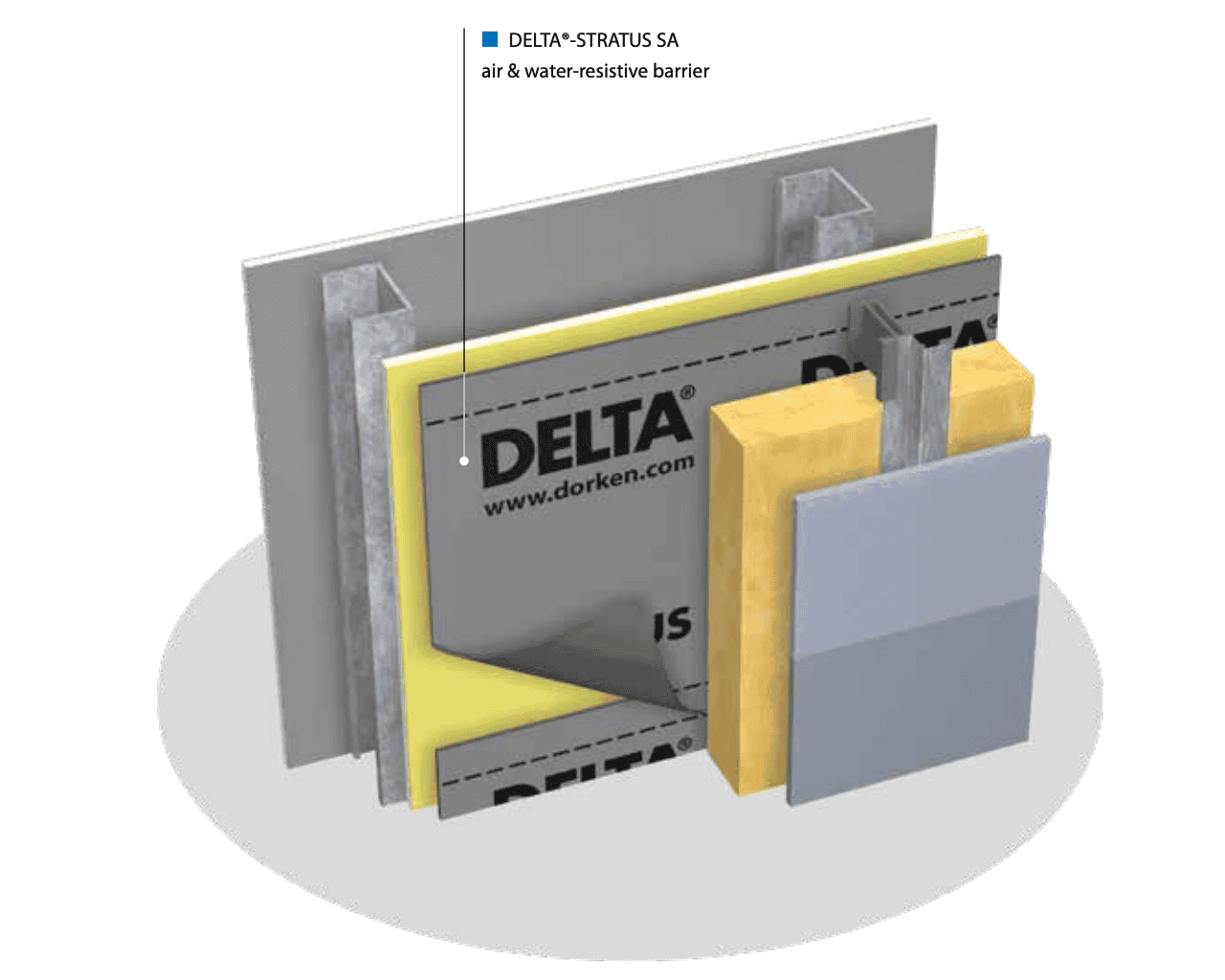
Manufactured by Dörken, DELTA®-STRATUS SA is a premium, four-layer, self adhered air barrier membrane and water-resistive barrier (WRB). Unlike standard wraps that rely on staples and tape, this is a sophisticated "peel-and-stick" system designed to create a monolithic, airtight seal across the entire building enclosure.
The Technical Edge: 4-Layer Innovation
-
High-Strength Spunbond Polypropylene (Bottom Layer): Provides the structural base.
-
Watertight Polymeric Middle Layer: The core drainage plane.
-
Second Polypropylene Layer: Adds reinforcement and protection.
-
Acrylic UV-Resistant Coating (Top Layer): The "secret sauce" that allows for industry-leading exposure times.
Why Custom Builders and Architects are Switching
For a product to be considered the best air barrier for exterior walls, it must solve expensive problems. Here is how DELTA®-STRATUS SA addresses the specific pain points of the building trades.
1. The 180-Day "Insurance Policy" (UV Stability)
Construction delays are a reality in 2026. Most standard wraps begin to degrade and lose water-repellency after 30 to 60 days of sun exposure.
-
The Feature: DELTA®-STRATUS SA is rated for 180 days of UV exposure in most climate zones (150 days in zones 1-2).
-
The Benefit: If your siding crew is delayed by three months, you don't have to worry about the membrane "baking" or losing its integrity. It stays functional until the final cladding is installed.
2. Eliminating the "Thousands of Holes" Problem
Every staple or cap-nail used in a traditional wrap is a potential leak point for both water and air.
-
The Feature: As a fully peel and stick house wrap, it uses a high-tack adhesive and a split-release liner.
-
The Benefit: You achieve a continuous air barrier without mechanical fasteners. This is critical for meeting stringent Blower Door Test requirements in Passive House or modern energy-code builds.
3. The "Sweet Spot" of Breathability (50 Perms)
There is a common misconception that an airtight self adhered air barrier membrane must be non-breathable.
-
The Feature: It boasts a 50 Perm rating (vapor permeability).
-
The Benefit: It allows moisture vapor inside the wall assembly to escape through diffusion. This prevents the "mold sandwich" effect where moisture gets trapped behind the membrane and rots the OSB or plywood sheathing.
Installation Efficiency
Time is money on a job site. DELTA®-STRATUS SA is designed to be installed by a two-person team with minimal margin for error.
-
Split-Release Liner: The backing is split down the middle, allowing you to "tack" the top half of a roll, level it, and then remove the bottom half. No more fighting with 10-foot sheets in the wind.
-
Tear Resistance: The spunbond layers make it incredibly difficult to rip, even in high-wind coastal environments.
-
Substrate Versatility: It bonds aggressively to OSB, plywood, concrete, masonry, and even glass-mat gypsum.
Comparison: DELTA®-STRATUS SA vs. The Competition
How does this delta stratus sa stack up against industry staples?

The Verdict: Is it Worth the Premium?
Yes, but specifically for projects where quality and long-term performance are non-negotiable.
If you are building a budget-focused "tract home" where the siding goes up in 48 hours, this may be overkill. However, for Custom Home Builders, Architects, and Commercial Contractors, the cost of one mold remediation or one failed blower door test far exceeds the price difference of this premium peel and stick house wrap.
Buy DELTA®-STRATUS SA if:
-
You are targeting Net-Zero or high-efficiency energy certifications.
-
You anticipate gaps between the WRB installation and the siding.
-
You want the best air barrier for exterior walls to eliminate moisture-related "call-backs."
Ready to Upgrade Your Building Envelope?
Don't risk your reputation on a house wrap that can't handle the sun or the wind. Secure your project with the industry's most durable air and water barrier.
Frequently Asked Questions (FAQ)
1. Does DELTA®-STRATUS SA require a primer?
In most standard applications (OSB/Plywood) at temperatures above 40°F (5°C), it does not require a primer. However, for concrete, masonry, or cold weather installations, using DELTA®-HF PRIMER ensures a permanent bond.
2. Can I use this with open-joint cladding?
While DELTA®-STRATUS SA has incredible UV resistance (180 days), it is intended for closed-cladding systems. For systems where the membrane will be permanently exposed to sunlight through open joints, we recommend DELTA®-FASSADE S.
3. How do I handle the laps and seams?
As a self adhered air barrier membrane, it is largely self-sealing at the laps. However, all horizontal and vertical laps should be rolled with a hand roller to ensure the pressure-sensitive adhesive is fully engaged.
4. Is it NFPA 285 compliant?
Yes, DELTA®-STRATUS SA has been tested and meets the requirements for NFPA 285 in many common wall assemblies, making it a safe choice for light commercial and multi-family use.
5. What makes it the "best air barrier for exterior walls" compared to traditional wraps?
Traditional wraps are not true air barriers because they are not fully bonded to the substrate; air can "loop" behind them. DELTA®-STRATUS SA creates a monolithic bond, stopping air movement and significantly improving the effective R-value of your insulation.