
Posted by Spycor LLC on Jun 24th 2025
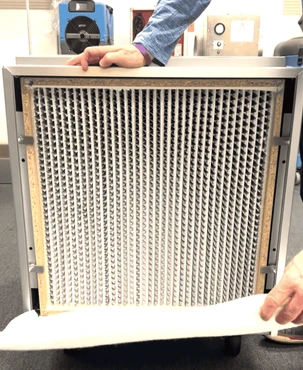
Replace a commercial HEPA filter when any of these happens:
- Its pressure drop reaches the manufacturer's rated final resistance, commonly about 2× the initial resistance.
- Airflow can no longer hold your required negative pressure or air changes.
- The filter is damaged, wet or fails a leak test.
- Your abatement plan, ICRA plan or SOP requires it.
Service life ranges from a single project in negative air machines to several years in well-prefiltered HVAC and cleanroom systems.
Your spec controls replacement. Follow your equipment manufacturer, project specification, ICRA plan or cleanroom SOP, and the authority having jurisdiction.
Shop All Commercial HEPA Filters →
Key Takeaways
- Pressure drop is the primary trigger. Calendar schedules aren't. Record the reading when you install a filter so you know its baseline.
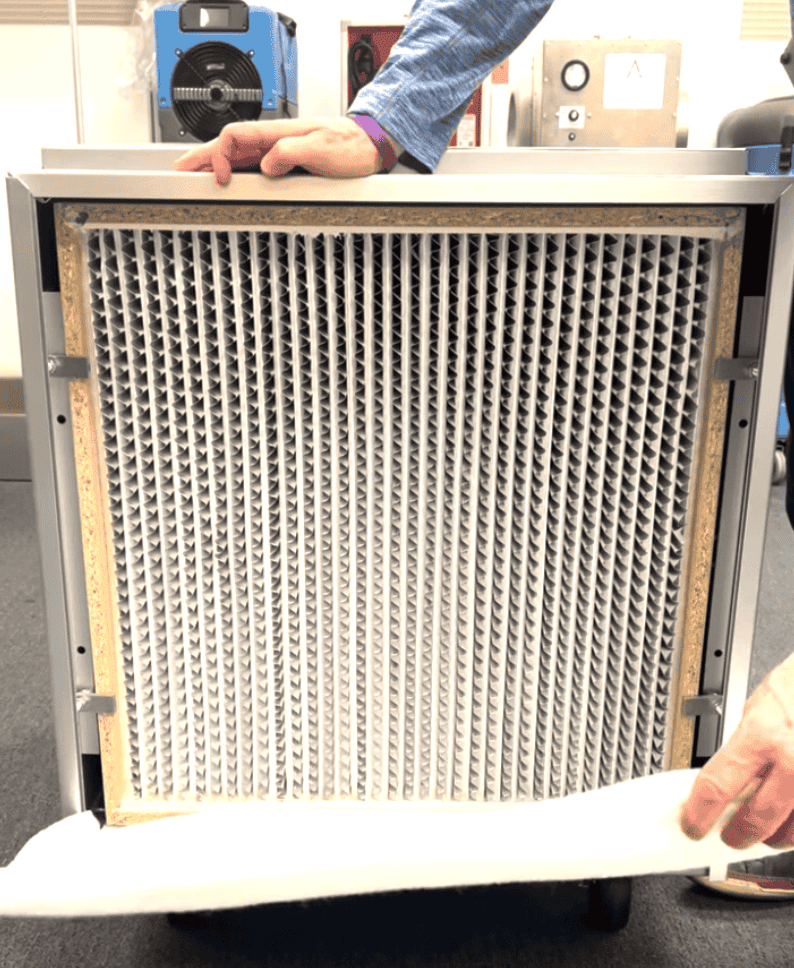
- Change pre-filters first. If resistance stays high after fresh pre-filters, the HEPA is loaded.
- Airflow loss is a containment failure. A loaded HEPA reduces CFM, air changes and negative pressure.
- Replace damaged, wet or leaking filters immediately, no matter their age.
- Don't wash, vacuum or blow out a disposable HEPA filter unless the manufacturer specifically permits a cleaning procedure.
The 5 Signs a Commercial HEPA Filter Needs Replacement
The five triggers are final resistance, airflow loss, physical damage, a failed leak test, and a procedure that requires replacement. Use this table to decide:
| What you see | Replace the HEPA? | What to do |
|---|---|---|
| Pressure drop at the rated final resistance | Yes | Replace |
| Reduced airflow or pressure differential | Check the pre-filter first | Install new pre-filters, then recheck |
| New pre-filter restores airflow | No | The HEPA still has life |
| New pre-filter doesn't restore airflow | Yes, likely | Inspect, then replace |
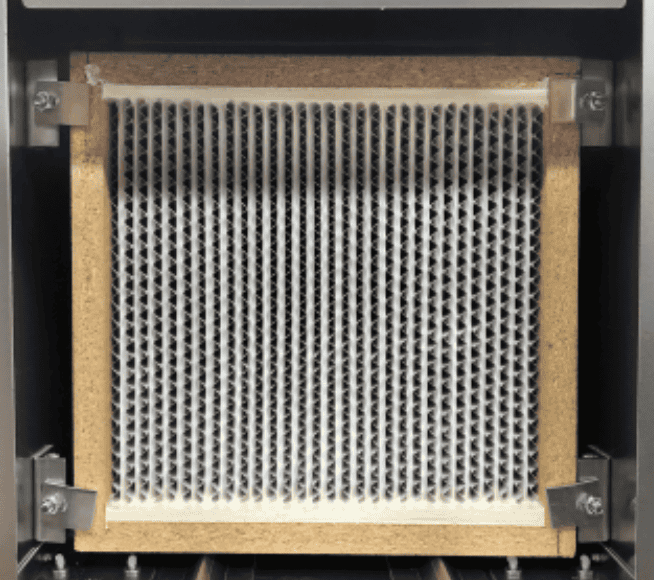
| Torn media, crushed gasket or bent frame | Yes | Replace immediately |
| Wet media or swollen particle board frame | Yes | Replace immediately |
| Failed leak or scan test | Yes | Replace, or repair per the manufacturer's procedure |
| Abatement plan, ICRA plan or SOP requires it | Yes | Replace and dispose per the plan |
| Filter is simply X months old | Not necessarily | Check resistance and airflow |
How to Use Pressure Drop to Time Replacement
Pressure drop (resistance) is measured in inches of water gauge (" w.g.) across the filter. It rises as the media loads.
- Record initial resistance at install. For example, a standard 24x24x11-1/2 HEPA at its rated 1,000 CFM typically starts around 1.0" w.g.
- Find the final resistance on the label. It's commonly about 2.0" w.g., roughly double the initial reading.
- Monitor at a set interval: daily on demo and abatement jobs, and on your PM schedule for HVAC and cleanroom systems.
- Rule out the pre-filter. If the gauge climbs, change the pre-filter and intermediate pleated filter first. If resistance stays near the final value, replace the HEPA.
Typical values are industry norms, not guarantees. Always use the ratings for your specific filter.
Verify performance: Room pressure monitors confirm your containment holds negative pressure. Particle counters confirm downstream air quality.
How Long Do Commercial HEPA Filters Last? (By Application)
| Application | Typical service life | Main replacement trigger |
|---|---|---|
| Negative air machines / air scrubbers: demo, drywall, sanding | Days to a few weeks | Final resistance; filter-change light |
| Fire & smoke restoration | Short. Soot loads media fast | Final resistance. For odors, add carbon filters, since HEPA doesn't remove gases |
| Mold remediation | Project-specific | Remediation protocol and contamination conditions |
| Asbestos & lead abatement | Typically one project | Abatement plan and applicable regulations, including disposal |
| ICRA / healthcare construction | Per project or phase | ICRA plan; loss of pressure differential |
| Healthcare & commercial HVAC (with MERV pre-filters) | Often multiple years | Final resistance; failed leak test |
| Cleanrooms, labs & laminar flow hoods | Often multiple years | Failed certification or leak scan; airflow velocity below spec |
These are typical ranges from field use, not guarantees. Dust load, runtime, humidity and pre-filtration drive actual life.
What Shortens HEPA Filter Life
- Missing or overloaded pre-filters. This is the #1 cause of early HEPA failure.
- Fine dust loads from drywall sanding, concrete grinding or insulation removal.
- Running above rated CFM. A filter rated below the machine's airflow loads faster.
- Moisture. Particle board frames can swell, and wet media loses integrity.
- Rough handling. A dropped filter or crushed gasket can leak even if it looks fine.
Protect your HEPA: Stage pre-filters and pleated filters on negative air machines, and MERV 8–15 filters ahead of HVAC HEPA banks. Pre-filters are cheap. Early HEPA replacement isn't.
What Not to Do
- Don't wash, vacuum or blow out a disposable HEPA filter unless the manufacturer specifically permits a cleaning procedure.
- Don't reuse abatement or mold-job filters on a clean job.
- Don't install a filter backward. Match the airflow arrow and gasket side.
- Don't ignore a wet particle board frame, even if it dried out.
Plan Spares Before the Job Starts
Running out mid-job stops containment. For active demo, restoration and abatement work:
- Keep at least one spare HEPA per machine on site.
- Stock pre-filters by the case, since they change far more often.
- Fleet operators should standardize on common sizes such as 24x24x11-1/2 to simplify inventory.
Need to confirm your size, efficiency or frame? See How to Choose the Right Commercial HEPA Filter. For step-by-step swap instructions, see the Negative Air Machine HEPA Filter Replacement Guide.
Order Replacement HEPA Filters
| Your equipment | Shop |
|---|---|
| Negative air machines & air scrubbers | Wood frame HEPA · Metal frame HEPA |
| Omnitec OA2200UL | Omnitec 24x24x12 HEPA, 99.97% |
| Omnitec OA2000V | Omnitec 24x18x12 HEPA, 99.97% |
| Healthcare HVAC, labs, cleanrooms | 99.99% metal frame · 99.999% metal frame |
| High-CFM machines & air handlers | 99.97% metal, high-capacity |
Not sure which filter fits? Call 1-877-293-0784 with your machine model or housing size. Volume and fleet orders are welcome.
Shop All Commercial HEPA Filters →
Frequently Asked Questions
How often should you replace a HEPA filter in an air scrubber or negative air machine?
Replace it when pressure drop reaches the manufacturer's final resistance or the filter-change light stays on after you install new pre-filters. On heavy demo or sanding jobs, that can take days to a few weeks. On abatement work, follow your abatement plan.
What is the final resistance of a HEPA filter?
Final resistance is the maximum pressure drop the manufacturer rates the filter for before replacement. It's commonly about 2.0" w.g., or roughly double the initial resistance. Check the label or spec sheet for your filter.
How long does a commercial HEPA filter last?
It ranges from a single project in negative air machines to several years in HVAC and cleanroom systems with good pre-filtration. Dust load, runtime, CFM and moisture determine actual life.
Can you clean and reuse a commercial HEPA filter?
Not a disposable commercial HEPA filter. Washing, vacuuming or blowing it out damages the glass-fiber media and seal, so it no longer meets its rated efficiency. Only clean a HEPA filter if the manufacturer specifically permits a cleaning procedure.
Should I replace the pre-filter or the HEPA filter first?
The pre-filter. If resistance drops back after a new pre-filter, the HEPA still has life. If it stays near final resistance, replace the HEPA.
Do you have to replace HEPA filters after asbestos or lead abatement?
Follow your abatement plan and applicable regulations. Filters from abatement work are typically removed at project end and disposed of as contaminated waste, not reused.
How do you know if a HEPA filter is leaking?
A particle counter downstream of the filter, or an aerosol (PAO/DOP) scan test, shows leaks. Cleanroom and healthcare filters are typically leak-tested at installation and at recertification.