
Posted by Spycor LLC on Jul 14th 2026
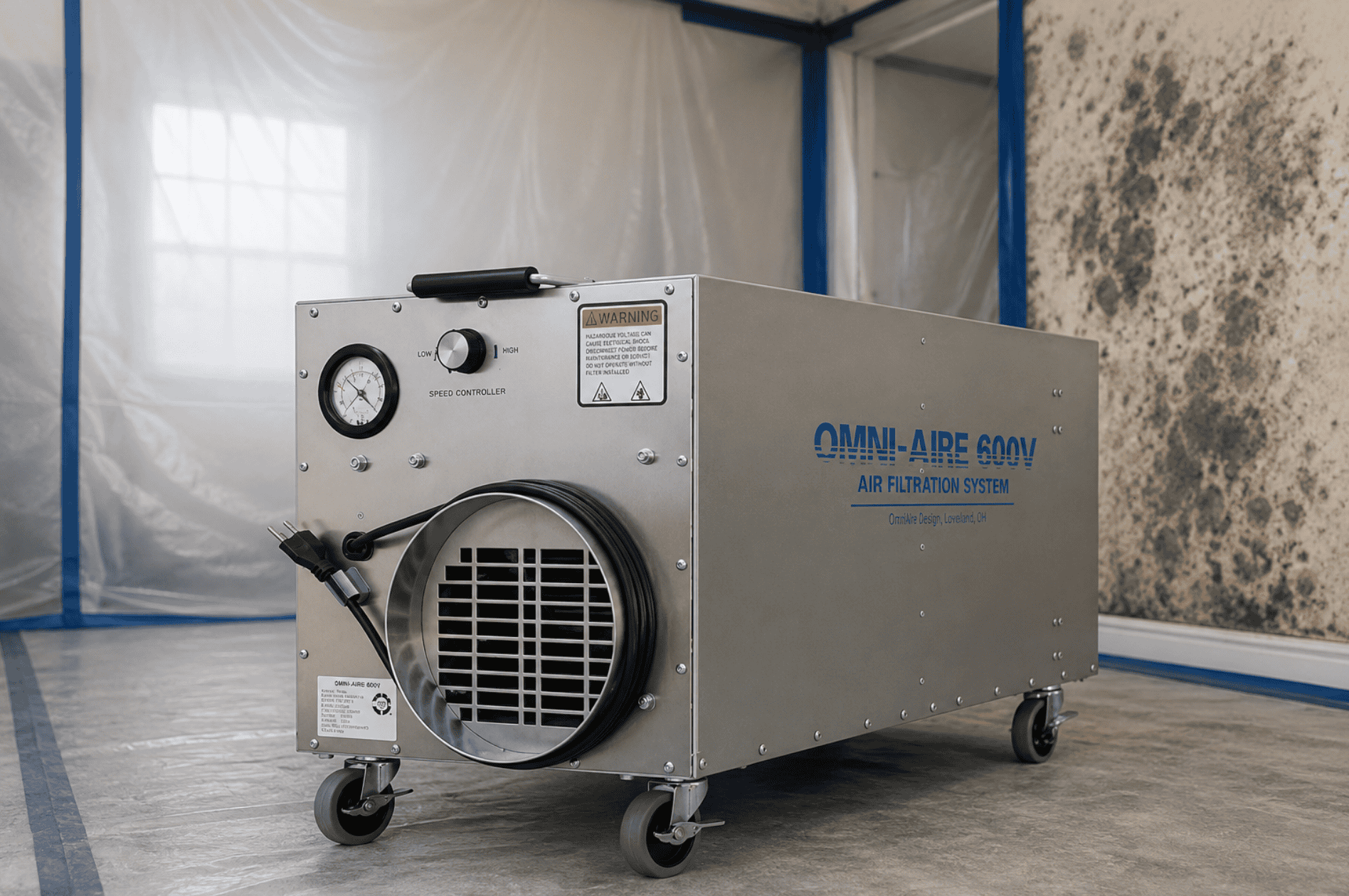
To size an air scrubber for mold remediation, calculate your containment area's volume (length × width × height in feet), multiply by your target air changes per hour (many remediation professionals design around approximately 6 ACH, though the right number depends on project conditions and applicable protocols), then divide by 60. The result is the CFM your equipment needs to deliver. A 1,500 sq ft basement with 8-foot ceilings targeting 6 ACH needs roughly 1,200 CFM — but CFM is the starting point, not the whole decision.
Undersizing an air scrubber is one of the most common — and most expensive — mistakes on a mold remediation job. Too little airflow and spores stay airborne, containment underperforms, and you're back on site for a callback. Oversizing wastes rental or capital budget you didn't need to spend. This guide gives you the formula, a sizing calculator, worked examples across common job types, and the equipment factors that matter beyond CFM alone.
At a Glance: Room Size to CFM
| Room / Containment Type | Approx. Volume (cu ft) | Target CFM (~6 ACH) |
|---|---|---|
| Bathroom / small containment | Up to 800 | 150-300 CFM |
| Bedroom | 800-1,500 | 300-600 CFM |
| Standard room / crawlspace | 1,500-3,000 | 450-750 CFM |
| Basement (mid-size) | 3,000-5,000 | 700-1,000 CFM |
| Classroom / multi-room containment | 5,000-8,000 | 1,000-1,600 CFM |
| Large basement / warehouse bay | 8,000-10,000 | 1,600-2,000 CFM |
| Hospital room / ICRA zone | 8,000-10,000 | Sized to facility ICRA/engineering requirements |
| Large-scale demolition / commercial | 10,000+ | 2,100-4,000 CFM |
This table is a planning reference, not a substitute for a project-specific engineering assessment. Full methodology and caveats below.
The CFM Formula
Step 1: Calculate volume. Length (ft) x Width (ft) x Height (ft) = Cubic Feet
Step 2: Multiply by your target air changes per hour (ACH). Many remediation professionals design containment systems for approximately 6 ACH during active mold remediation work, though the appropriate airflow depends on project conditions, containment design, contamination level, and the remediation protocol governing the job. Always confirm the ACH target required for your specific project rather than defaulting to a single number.
Step 3: Divide by 60. Cubic Feet x ACH / 60 = Required CFM
Worked Examples Across Job Types
| Scenario | Dimensions | Volume | Target ACH | Required CFM |
|---|---|---|---|---|
| Residential bathroom | 8' x 10' x 8' | 640 cu ft | 6 | ~65 CFM |
| Basement remediation | 20' x 25' x 8' | 4,000 cu ft | 6 | ~400 CFM |
| School classroom | 25' x 30' x 10' | 7,500 cu ft | 6 | ~750 CFM |
| Hospital room (ICRA zone) | 15' x 20' x 9' | 2,700 cu ft | Per facility ICRA requirement | Confirm with facility engineering / infection control |
| Warehouse containment bay | 40' x 50' x 16' | 32,000 cu ft | 6 | ~3,200 CFM |
| Commercial office suite | 30' x 40' x 9' | 10,800 cu ft | 6 | ~1,080 CFM |
For any healthcare or facility-governed environment, treat the ACH target as a project-specific requirement set by the facility's Infection Control Risk Assessment (ICRA) and engineering controls, not a fixed universal number. Confirm requirements with the facility before sizing equipment.
CFM Calculator
[Embed: interactive calculator, inputs for room length, width, height, and target ACH; outputs required CFM and a recommended in-stock unit from the comparison table below. Downloadable Excel worksheet and printable PDF sizing chart to accompany the embedded tool.]
Sizing Decision Tree
Is your containment area under 1,500 cubic feet?
- YES: Target range 150-600 CFM. Need ducted exterior exhaust? If yes, size toward the upper end of the range to offset duct resistance. If no, a standard portable unit is typically sufficient.
- NO: Is it under 8,000 cubic feet?
- YES: Target range 700-1,600 CFM. Is the space irregularly shaped or does it have obstacles? If yes, consider two smaller units in a push-pull configuration. If no, a single mid-range unit is typically sufficient.
- NO: Target range 1,600-4,000+ CFM. Is this a healthcare or facility-governed environment? If yes, confirm ACH and equipment requirements with facility ICRA/engineering. If no, size to large-containment or commercial-grade equipment.
- YES: Target range 700-1,600 CFM. Is the space irregularly shaped or does it have obstacles? If yes, consider two smaller units in a push-pull configuration. If no, a single mid-range unit is typically sufficient.
[Illustration: diagram showing Length x Width x Height -> Volume -> ACH -> Required CFM, for visual reference alongside the formula above.]
It's Not Just CFM: What Else Determines the Right Machine
Rated CFM is the starting point for sizing, not the full equipment decision. Contractors selecting equipment for a real job should also weigh:
- Pressure drop and duct compatibility - a machine's rated CFM assumes a clean filter with no ducting attached; static pressure loss through ducting reduces real-world airflow, and the amount varies by duct length, bends, filter loading, and machine design
- Noise level - relevant for occupied buildings, schools, and healthcare settings where low-noise operation may be required
- Portability and daisy-chain capability - matters for multi-room jobs or crews moving between containment zones
- Power requirements - amp draw and outlet availability, especially when running multiple units off one circuit
- Filter availability and replacement cost - ongoing cost of ownership on longer jobs
- Cabinet durability - stackability, transport durability, and jobsite abuse resistance for daily contractor use
A unit rated at the CFM your calculation requires may still be the wrong choice if it can't meet these secondary requirements for your specific job.
Common Sizing Mistakes
Ignoring ceiling height. A 20' x 20' room has 75% more air volume at a 14-foot ceiling than at an 8-foot ceiling. Always calculate cubic feet, not square footage alone.
Assuming nameplate CFM equals real-world CFM. Manufacturer CFM ratings are typically measured with a clean filter and no ducting attached. Actual airflow on a live job can be lower due to HEPA filter loading over time and resistance from ducted exhaust runs. Plan with some headroom rather than sizing to the exact calculated minimum.
Applying residential air-purifier ACH targets to a jobsite. Homeowner air purifier guidance (often 2-4 ACH) is built for ambient comfort, not active containment. Mold remediation work typically calls for a higher ACH target during active work than a home air purifier would ever need to hit.
Treating healthcare ACH as universal. Healthcare and facility-governed containment zones are typically sized around a project-specific Infection Control Risk Assessment (ICRA) and the facility's engineering controls, not a single fixed ACH number. Always confirm with facility engineering or infection control before finalizing equipment.
Equipment Comparison by CFM Tier
| Machine | Rated CFM | Best For |
|---|---|---|
| Nikro PS600 Mini Poly Air Scrubber | Up to ~300 CFM | Bathrooms, small residential containment |
| OMNIAIRE OA600V | 150-600 CFM (variable) | Bedrooms, small rooms, flexible jobsite use |
| PRED750 Predator Portable Air Scrubber | Up to 750 CFM | Standard rooms, crawlspaces |
| PAS1200 Portable Air Scrubber | 150-900 CFM (variable) | Basements, mixed-size jobs, contractors wanting one flexible unit |
| Predator 1200 with UV Light | 300-1,000 CFM | Sensitive environments needing added microbial control |
| PAS2400 Portable Air Scrubber | 700-2,100 CFM (two-speed) | Large basements, multi-room containment |
| OMNI-AIRE OA2200CMED | ~2,000 CFM, 99.99% medical-grade HEPA | Healthcare / ICRA-governed containment zones |
| PAS5000 Portable Air Scrubber | Up to 4,000 CFM peak | Large-scale demolition, commercial and industrial jobs |
Questions Contractors Ask Before Buying
Is a 500 CFM air scrubber enough?
It depends on the volume of the space and your target ACH. Using the formula above, a 500 CFM unit at 6 ACH comfortably covers roughly 5,000 cubic feet, a mid-size room or small basement. For larger or irregularly shaped spaces, confirm with the calculator rather than assuming.
Can one air scrubber cover two rooms?
Only if air can circulate freely between them (open doorways, connected containment). Closed-off rooms need independent coverage or ducting between spaces.
Should I oversize an air scrubber?
Modest headroom above your calculated minimum is reasonable to offset filter loading and duct resistance over the course of a job. Significant oversizing adds unnecessary noise, power draw, and equipment cost without proportional benefit.
Is CADR the same as CFM?
No. CADR (Clean Air Delivery Rate) is a consumer air-purifier metric that already accounts for filtration efficiency, while CFM is a raw airflow measurement. Commercial air scrubbers are typically rated in CFM, not CADR.
Does ducting reduce airflow?
Yes. Ducted exhaust runs add static pressure that reduces a machine's real-world CFM output compared to its nameplate rating. Longer runs and more bends increase the effect.
Can I exhaust outside?
Yes, ducting an air scrubber's exhaust outdoors is standard practice for creating negative pressure and keeping contaminated air from escaping into clean areas of a building.
Should I run continuously?
During active remediation, air scrubbers are typically run continuously throughout the containment period to maintain negative pressure and continuously reduce airborne spore counts as materials are disturbed.
Does HEPA filtration affect airflow?
Yes. HEPA filters create more resistance than basic pre-filters, and airflow decreases further as the filter loads with particulate over the course of a job, another reason to size with headroom rather than to the exact calculated minimum.