
Posted by Spycor Building on May 20th 2026
Whether you’re a homeowner trying to understand your options, a general contractor specifying a system, or a waterproofing professional managing deep commercial excavations — choosing the right foundation waterproofing membrane is one of the most consequential decisions in any below-grade construction project.
Water intrusion is the leading cause of foundation damage in North America. According to industry estimates, water damage repairs average $5,000 to $10,000 per incident — and structural foundation failures cost far more. The right membrane selected at the design phase eliminates these risks before they start.
This guide covers every major membrane type on the market, explains when each is the right tool for the job, and provides expert-level detail on the four highest-performing dimpled drainage systems available to professional contractors today.

Types of Foundation Waterproofing Membranes: Which Do You Actually Need?
Before selecting a specific product, you need to understand the five main categories of foundation waterproofing materials. Most failed waterproofing systems result from choosing the wrong category — not a bad product within the right one.
1. Liquid-Applied Membranes
Liquid-applied membranes are spray or roller-applied coatings that cure into a seamless waterproof barrier. They’re popular for irregular surfaces and retrofit applications. Common formulations include rubberized asphalt, polyurethane, and elastomeric polymers that offer up to 900% elongation to accommodate foundation movement.
Best for: Retrofit waterproofing, irregular surfaces, and projects where seamless coverage is critical.
Limitation: Requires 24–48 hours of cure time before backfilling. Cannot be applied in freezing temperatures. Does not relieve hydrostatic pressure.
2. Peel-and-Stick Sheet Membranes (Self-Adhering)
Pre-formed rolls with a factory-applied adhesive backing, typically rubberized asphalt or modified bitumen. Products like Henry Blueskin WP 200 are common in residential new construction. They deliver consistent, uniform thickness and can bridge minor hairline cracks.
Best for: New residential construction on flat, smooth surfaces where a bonded, seamless barrier is required.
Limitation: Requires primer. Sensitive to surface contamination. Does not actively drain water away from the wall.
3. Cementitious Coatings
Cement-based coatings are mixed on-site and applied by brush or spray. They bond directly to concrete and masonry, offering solid vapor protection. Common for interior positive-side applications and on block walls.
Limitation: Rigid and brittle — will crack when the foundation settles. Not suitable for areas with hydrostatic pressure.
4. Bentonite Clay Systems
Bentonite clay panels or sheets hydrate on contact with water, swelling to seal cracks and pores. Historically used in commercial blindside and tunnel waterproofing applications. Highly effective under constant hydrostatic pressure.
Limitation: Expensive. Installation requires careful sequencing. Can be compromised by saltwater or chemically contaminated soils.
5. Dimpled HDPE Drainage Membranes (Air-Gap Systems)
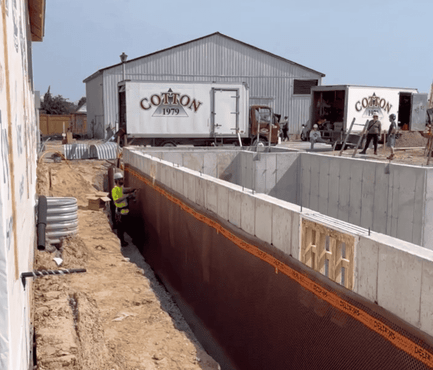
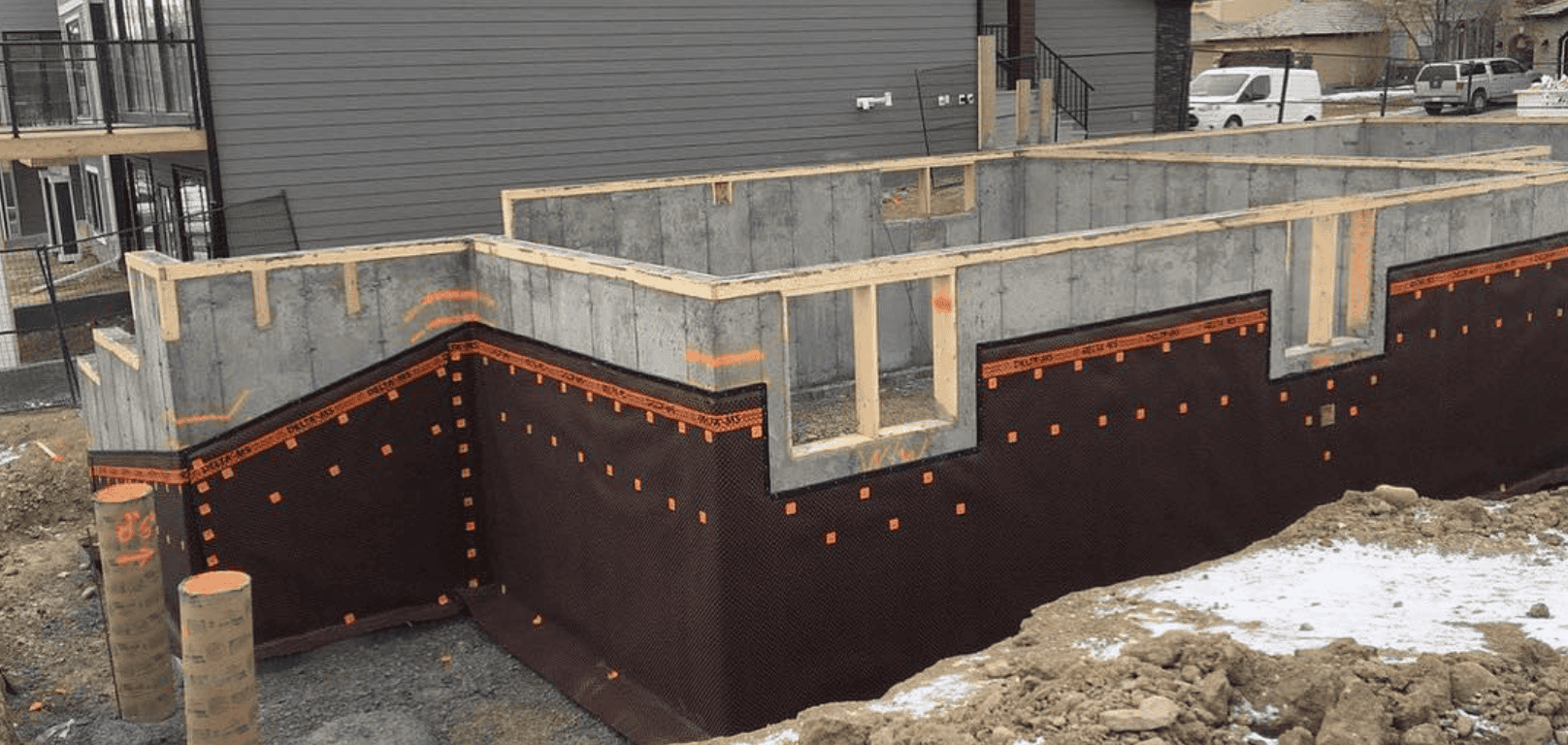
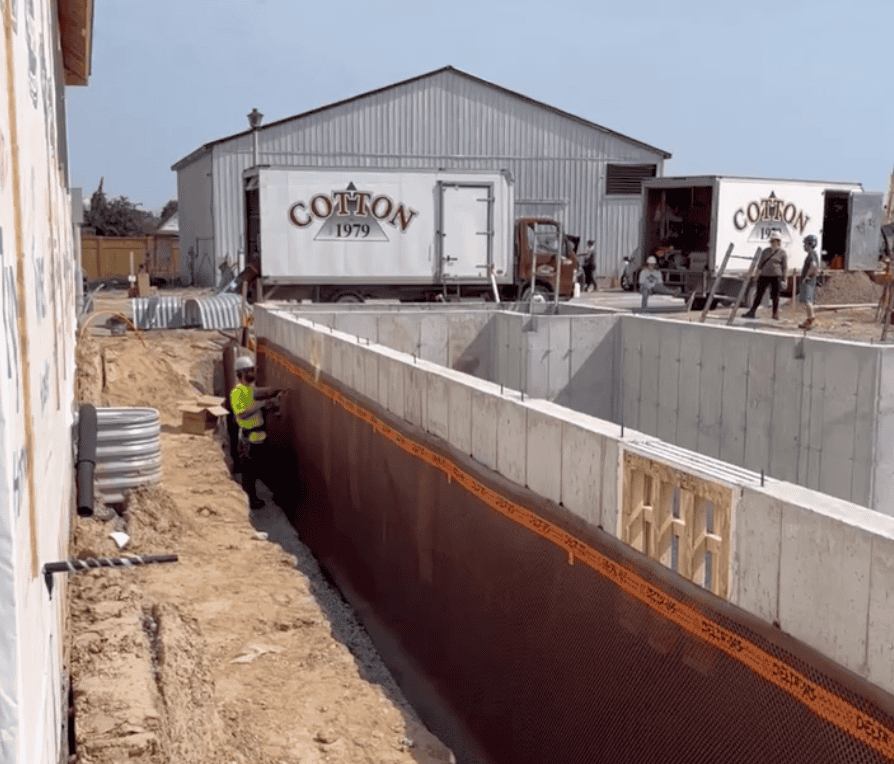
High-Density Polyethylene (HDPE) dimpled membranes are the current professional standard for subgrade waterproofing in both residential and commercial applications. Unlike coatings that try to stop water at the wall surface, dimpled membranes create a physical air gap between the soil and the foundation wall. This gap routes water downward to the footing drain by gravity, eliminating hydrostatic pressure entirely.
Best for: All new subgrade construction, from residential basements to deep commercial foundations. Mechanically fastened systems can bridge settlement cracks, require no cure time, and can be backfilled immediately.
Code note: IRC Section R406 and IBC Section 1805 distinguish between dampproofing and waterproofing. Asphalt coatings meet dampproofing standards only. True waterproofing — required in most jurisdictions with hydrostatic pressure conditions — requires systems with measurable resistance to liquid water under pressure. Dimpled HDPE systems, especially those with integrated geotextiles, meet this higher standard.

Technical Comparison: The 4 Best Dimpled Foundation Waterproofing Membranes
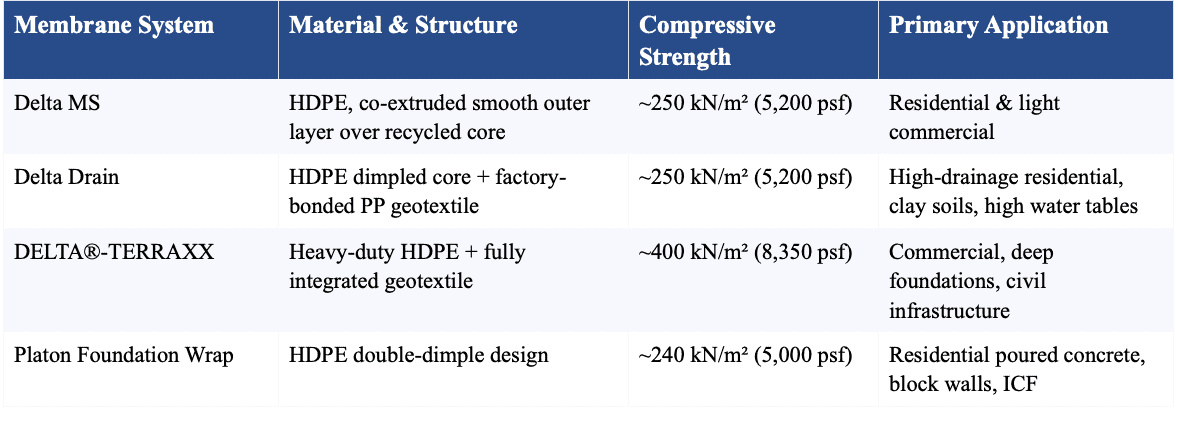
For subgrade applications where dimpled drainage systems are specified, four products dominate the professional market. Here is how they compare at a glance:
1. Delta MS: The Premium Standard for Residential and Light Commercial Protection
Delta MS is a vacuum-formed, dimpled HDPE foundation waterproofing membrane engineered for permanent subgrade wall protection. Its co-extruded design combines a virgin polymer outer layer with a recycled HDPE core, maximizing both tensile strength and environmental stress-crack resistance.
The product’s 8 mm (5/16-inch) dimple height creates a continuous air gap when mechanically fastened dimples-in against the foundation wall. This gap isolates the damp soil from the concrete structure and acts as a pressure-equalization path — any vapor or water that passes through the concrete flows down to the perimeter footing tile by gravity.
Why Contractors Choose Delta MS
- Bridges settlement cracks up to 1/4 inch without loss of system integrity — unlike spray coatings that rupture when concrete shrinks
- Zero cure time required: installation begins immediately after form stripping, saving up to 28 days vs. elastomeric coatings
- Impervious to soil acids, alkalis, and root penetration for a service life exceeding 50 years
- Accepted under IRC Section R406 waterproofing provisions in most jurisdictions
Recommended for: Standard residential basements and light commercial foundations in sandy or loam soils up to 12 feet of depth.
2. Delta Drain: High-Capacity Hydrostatic Relief with Integrated Filtration
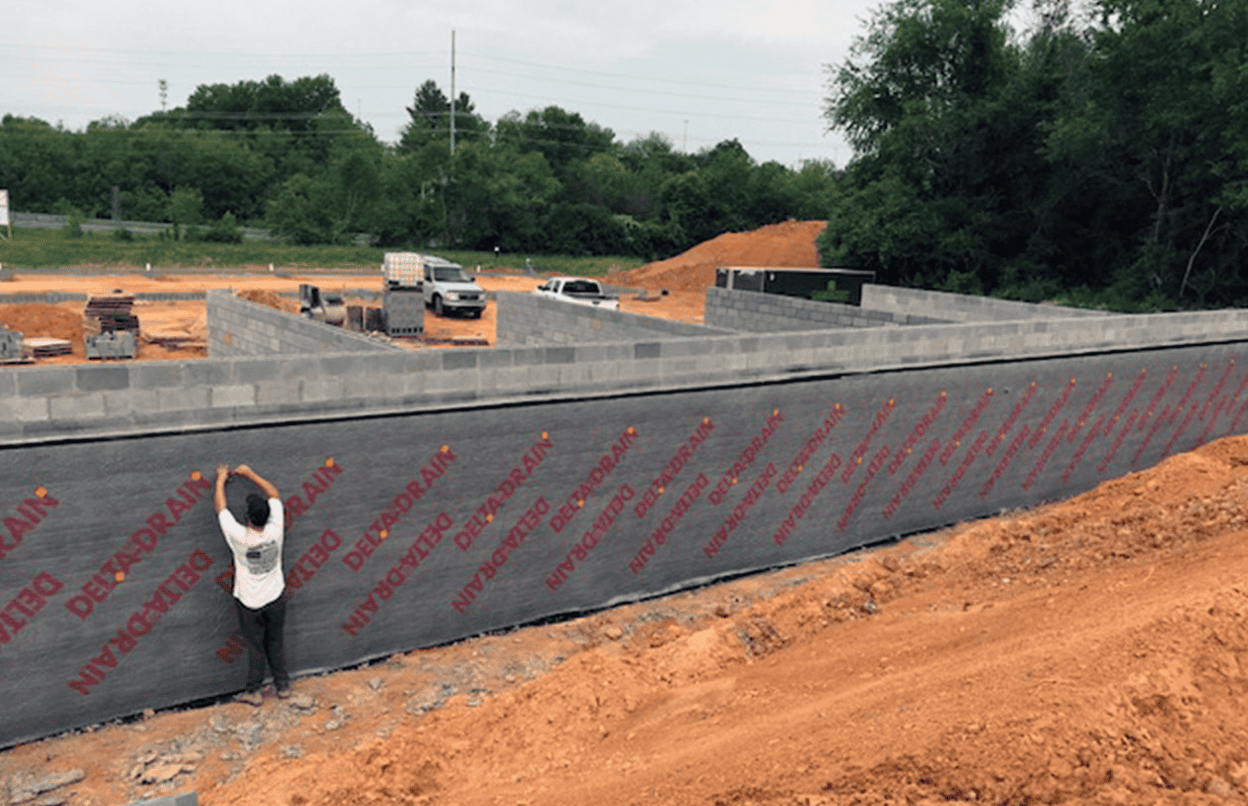
When subgrade conditions involve heavy clay soils, high water tables, or perched water tables, a simple air-gap membrane is insufficient. Delta Drain solves this challenge by combining an HDPE dimpled core with a factory-bonded polypropylene (PP) geotextile fabric.
Installed with the geotextile facing the soil, Delta Drain acts as a vertical drainage path and filter simultaneously. The non-woven fabric blocks fine soil particles from clogging the drainage channels, while water passes freely into the dimpled cavity and routes by gravity to the footing drain. The result: complete elimination of hydrostatic pressure buildup against the foundation wall.
Why Contractors Choose Delta Drain
- Two-in-one assembly: eliminates the separate step of installing a drainage board over a protection sheet, cutting labor hours on deep excavations
- Handles significantly higher water volume than aggregate backfill, meeting code requirements for wet soil conditions
- Acts as a rugged protection layer against sharp backfill materials (crushed stone, demolition debris)
- Transforms dynamic hydrostatic load into a managed gravity drain, extending the lifespan of any primary liquid waterproofing underlayment
Recommended for: Heavy clay soils, high or perched water tables, residential basements and light commercial applications up to 16 feet of depth.
3. DELTA®-TERRAXX: High-Load Commercial and Deep Subgrade Infrastructure
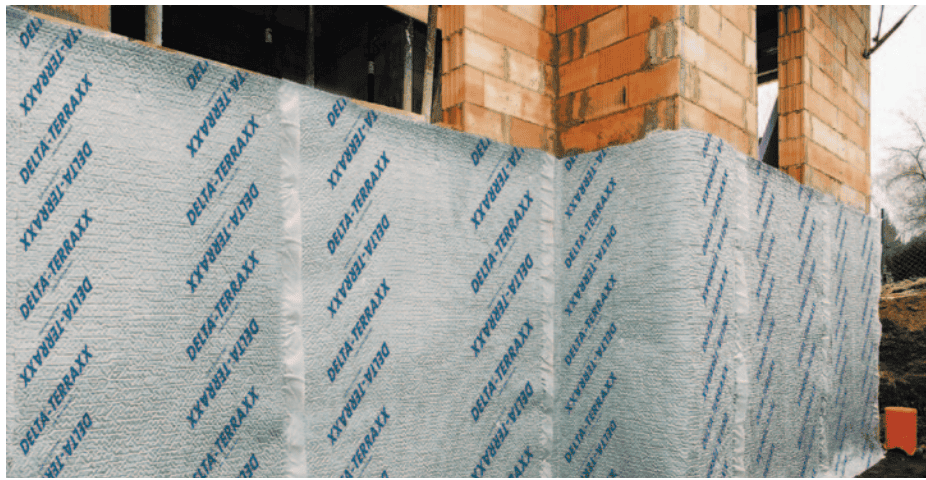
Commercial foundations, multi-family developments, and deep multi-level basements face compressive demands that standard residential membranes simply cannot handle. At depth, lateral earth pressure can flatten residential-grade dimples, collapsing drainage channels and rendering the membrane ineffective.
DELTA®-TERRAXX is engineered specifically for these extreme conditions. Its compressive strength of approximately 400 kN/m² (8,350 psf) — nearly double that of residential membranes — ensures drainage channels remain fully open even at depths where standard products fail. The fully integrated silver-colored geotextile provides clean soil filtration for long-term drainage performance.
Why Commercial Developers Specify DELTA®-TERRAXX
- Rated for deep excavations, lagging walls, blindside waterproofing, and civil infrastructure projects exceeding 20 feet
- High in-plane water flow capacity exceeds strict commercial building code drainage requirements
- Factory-installed adhesive seam edges speed installation and prevent soil intrusion during backfilling
- Supports architectural submittal packages and engineering specification requirements
Recommended for: Heavy industrial foundations, commercial blindside waterproofing, civil retaining walls, and any application exceeding 20 feet of subgrade depth.
4. Platon Foundation Wrap: The Double-Dimple Isolation Barrier
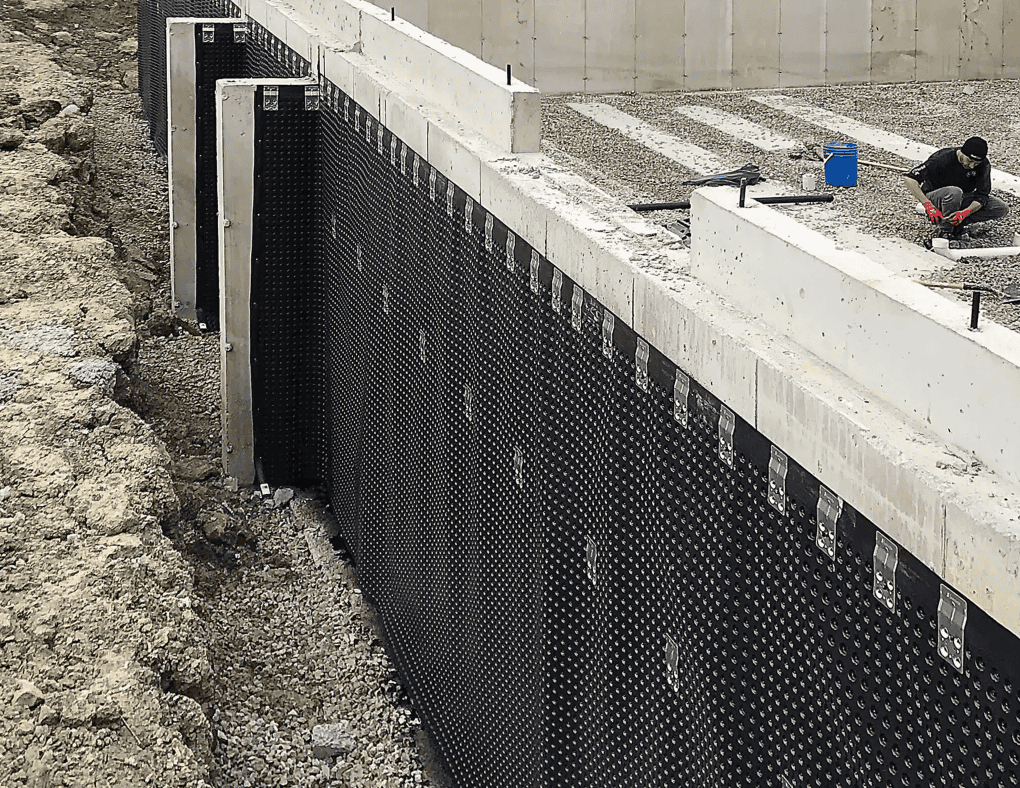
Platon Foundation Wrap takes a distinctive approach with its patented double-dimple HDPE design. Unlike single-dimple products that create an air gap on one side only, Platon’s double configuration creates an air gap on both sides of the membrane, isolating the foundation wall from soil moisture while allowing the concrete to breathe and dry outward.
This breathability is critical: concrete naturally retains moisture, and trapping it between an impermeable coating and the wall can accelerate degradation. Platon’s open air-gap system prevents this. It is also the preferred system for Insulated Concrete Form (ICF) construction, where it protects the delicate expanded polystyrene (EPS) foam from backfill puncture, UV exposure, and soil chemical degradation.
Why Custom Home Builders Choose Platon
- Compatible with poured concrete, concrete block, and ICF foundations — the most versatile dimpled membrane on the market
- Can be installed in freezing temperatures and wet conditions, eliminating weather delays that halt liquid-applied coatings
- Double-dimple design provides extra thermal cushion and vapor path, stabilizing foundation wall temperatures and controlling interior humidity
- Cost-effective: eliminates the need for separate fiberglass protection boards
- Backed by warranties up to 30 years; consistently rated highly by contractors on Contractor Talk and similar professional forums for ICF and below-grade applications
Recommended for: Residential poured concrete, block walls, and ICF foundations in all soil types up to 14 feet of depth.
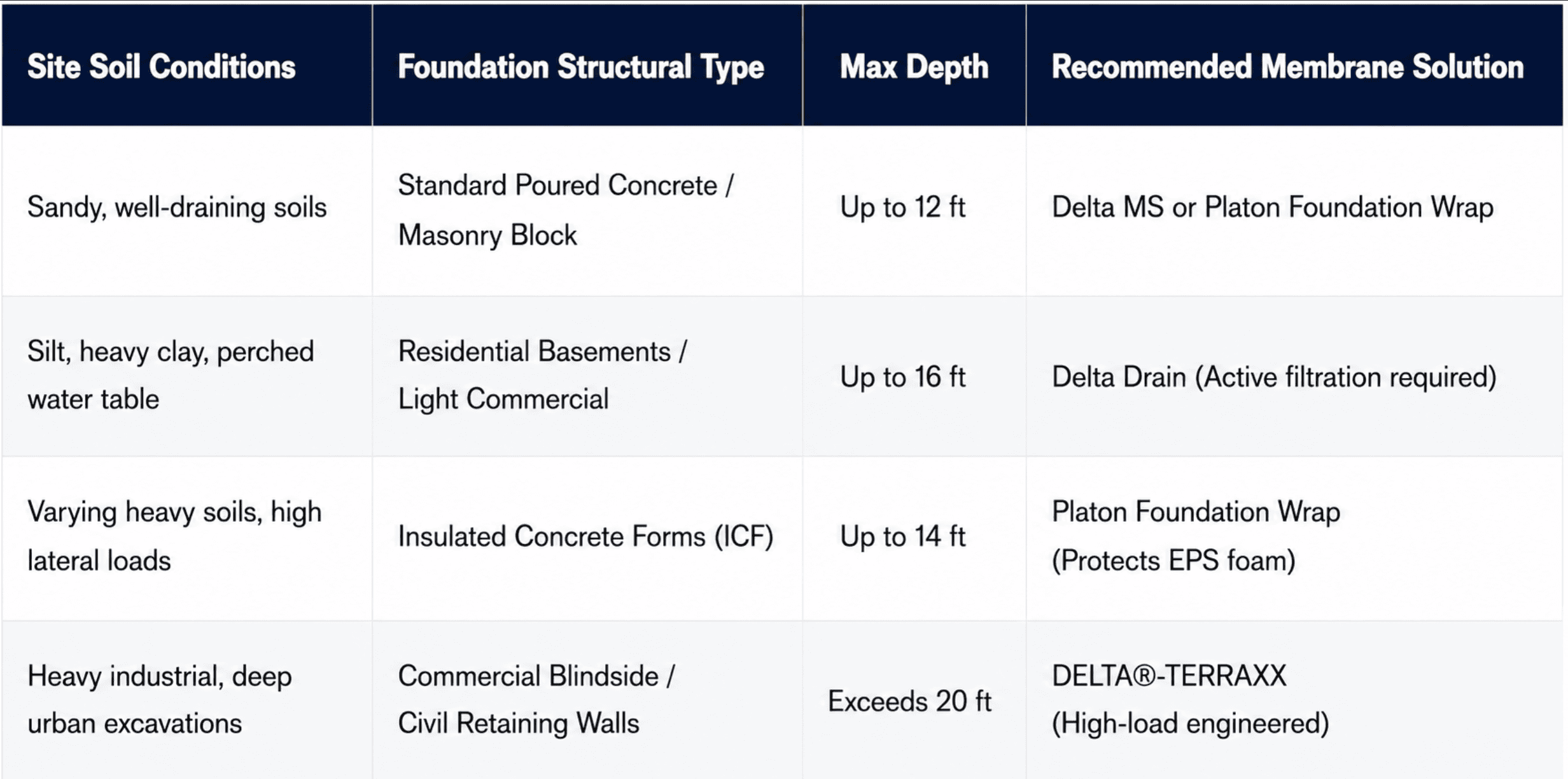
Commercial Selection Matrix: Match Your Site Conditions to the Right Membrane
Over-engineering wastes budget. Under-specifying creates callbacks. Use this matrix to make the correct call on your first specification:
Foundation Waterproofing Membrane Cost: What to Budget
Material cost is only one component of total system cost. When calculating true cost, account for material, labor, cure time, and callback risk.
As a general framework for comparison:
- Asphalt/damp-proofing coatings: Lowest upfront material cost, but require cure time, do not meet waterproofing code in most wet conditions, and carry significant callback risk.
- Liquid-applied elastomeric membranes: Moderate cost. Effective when properly applied to ideal surfaces. Add 1–2 days cure time to the schedule.
- Delta MS and Platon Foundation Wrap: Mid-range material cost. Eliminate cure time delays and labor for separate protection boards. Fastest installed system on most residential jobs.
- Delta Drain: Slightly higher material cost than single-layer systems. Eliminates the separate drainage board installation step, producing net labor savings on wet-soil applications.
- DELTA®-TERRAXX: Premium material cost justified by extreme-load performance and the elimination of system failure risk on deep commercial excavations where remediation costs are prohibitive.
For volume pricing, bulk freight quotes, and project-specific cost comparisons, contact the Spycor technical team at SpycorBuilding.com.
Installation Best Practices for Dimpled Foundation Membranes
Even the highest-performing foundation waterproofing membrane will fail if installed incorrectly. Follow these contractor-verified best practices:
- Surface preparation: Inspect the wall and fill voids larger than 1/4 inch with hydraulic cement or approved mortar before membrane application. Delta MS and Platon can bridge cracks up to 1/4 inch; larger voids require repair first.
- Mechanical fastening: Use the manufacturer-specified washer-head fasteners at the required spacing. Insufficient fastening allows membrane displacement during backfilling.
- Lap and seal all seams: Horizontal laps should run shingle-style (upper over lower). Vertical seams require manufacturer-approved tape or factory adhesive edges (DELTA®-TERRAXX includes factory adhesive seam tape).
- Extend to footing drain: The membrane must terminate at or below the top of the footing drain tile. Stopping short creates a gap where hydrostatic pressure can build.
- Immediate backfill advantage: Unlike liquid-applied systems, HDPE membranes (Delta MS, Delta Drain, Platon) can be backfilled immediately after mechanical fastening is confirmed. Use this to compress your schedule.
- Cold weather: Platon Foundation Wrap can be installed in freezing conditions. Liquid adhesives and elastomeric coatings cannot. Plan accordingly for winter pours.
Browse Spycorbuilding.com’s complete lineup of professional-grade foundation waterproofing membranes — Delta MS, Delta Drain, DELTA®-TERRAXX, and Platon Foundation Wrap — all stocked and ready to ship.
►► Click Here to Browse the Full Product Catalog ◄◄
Frequently Asked Questions: Foundation Waterproofing Membranes
What is the difference between foundation damp-proofing and foundation waterproofing?
Damp-proofing uses thin asphalt or cementitious coatings that resist vapor transmission in well-draining soils, but cannot bridge concrete cracks or stop liquid water under pressure. The IRC and IBC distinguish between these systems by code: damp-proofing coatings do not qualify as waterproofing in jurisdictions requiring hydrostatic resistance. Foundation waterproofing membranes — such as Delta MS or Platon Wrap — are engineered HDPE structures that bridge structural cracks, create active drainage channels, and eliminate hydrostatic pressure buildup.
Which foundation waterproofing membrane works best with ICF construction?
Platon Foundation Wrap is the top-specified membrane for Insulated Concrete Form (ICF) foundations. Its double-dimple design protects the fragile expanded polystyrene (EPS) foam from backfill rock puncture and soil chemical degradation without requiring a separate protection board. Delta MS is also compatible with ICF walls as a secondary option.
When do I need a geotextile fabric layer on my dimpled membrane?
A factory-bonded geotextile is required when working with fine silt, heavy clay soils, or any condition with a high or perched water table. Without the geotextile filter, fine soil particles migrate into the drainage channels over time, clogging them and re-introducing hydrostatic pressure. Delta Drain and DELTA®-TERRAXX both include integrated geotextiles for these conditions.
Can Delta MS and Platon be backfilled immediately after installation?
Yes — this is one of the primary schedule advantages of mechanically fastened HDPE systems. Unlike liquid-applied elastomeric or rubberized asphalt coatings that require 24 to 48 hours of cure time, Delta MS and Platon Foundation Wrap can be backfilled as soon as mechanical fastening is complete. This advantage compounds on large projects where cure delays affect multiple downstream trades.
How does lateral soil pressure affect deep subgrade drainage boards?
Deep subgrade applications generate extreme lateral soil loads that can flatten the dimples on residential-grade membranes, closing the drainage channels entirely and eliminating the hydrostatic pressure relief the system was installed to provide. For excavations exceeding 16 feet, specify DELTA®-TERRAXX, which delivers 400 kN/m² (8,350 psf) of compressive strength — nearly double residential-grade products.
Is a foundation waterproofing membrane required by building code?
In most jurisdictions with basements or below-grade living space, yes. IRC Section R406 requires waterproofing (not just damp-proofing) when the site has a water table within 6 inches of the bottom of the floor, or where hydrostatic pressure exists. IBC Section 1805 contains parallel requirements for commercial construction. Always verify with the Authority Having Jurisdiction (AHJ) for your specific project location and soil conditions.
What is the best foundation waterproofing membrane for a residential basement?
For most residential basements in sandy or loam soils, Delta MS or Platon Foundation Wrap provide optimal performance at a cost-effective price point. For clay soils, high water tables, or perched water tables, upgrade to Delta Drain for its active filtration and drainage capabilities. All three are mechanically fastened, require no cure time, and can bridge minor settlement cracks that would rupture spray-applied coatings.