
Posted by Spycor Building on Jun 27th 2025
A dry basement requires three integrated systems working together: an exterior waterproofing membrane (such as a dimpled HDPE membrane) to stop water intrusion, a drainage system to relieve hydrostatic pressure and carry groundwater away from the foundation, and a capillary break to prevent moisture from wicking up through concrete. Skipping any one of the three is the most common reason basements stay wet even after work has been done.
Basements fail for a specific, predictable set of reasons — and they're fixable with the right combination of products, not guesswork. This guide breaks down the three systems that make up a genuinely dry basement, compares the products used for each, and gives contractors and builders a specification-ready reference for below-grade projects.
Why Basements Leak
Basements sit below grade, which means they're in constant contact with soil moisture, groundwater, and hydrostatic pressure that pushes water toward the path of least resistance — usually a foundation wall or slab joint. Left unmanaged, this leads to:
- Moisture intrusion that drives mold and mildew growth
- Structural damage, as water exploits and widens concrete cracks over time
- Energy loss, since basements without a proper thermal/moisture boundary can account for a meaningful share of a home's total heat loss
- Soil gas infiltration (radon, methane) through untreated slab and wall penetrations
Addressing this requires treating waterproofing, drainage, and moisture control as three distinct but connected systems — not one product doing all three jobs.
Pillar 1: Waterproofing — Choosing the Right Membrane
The waterproofing layer is your first line of defense against water intrusion at the foundation wall. Two approaches dominate the market:
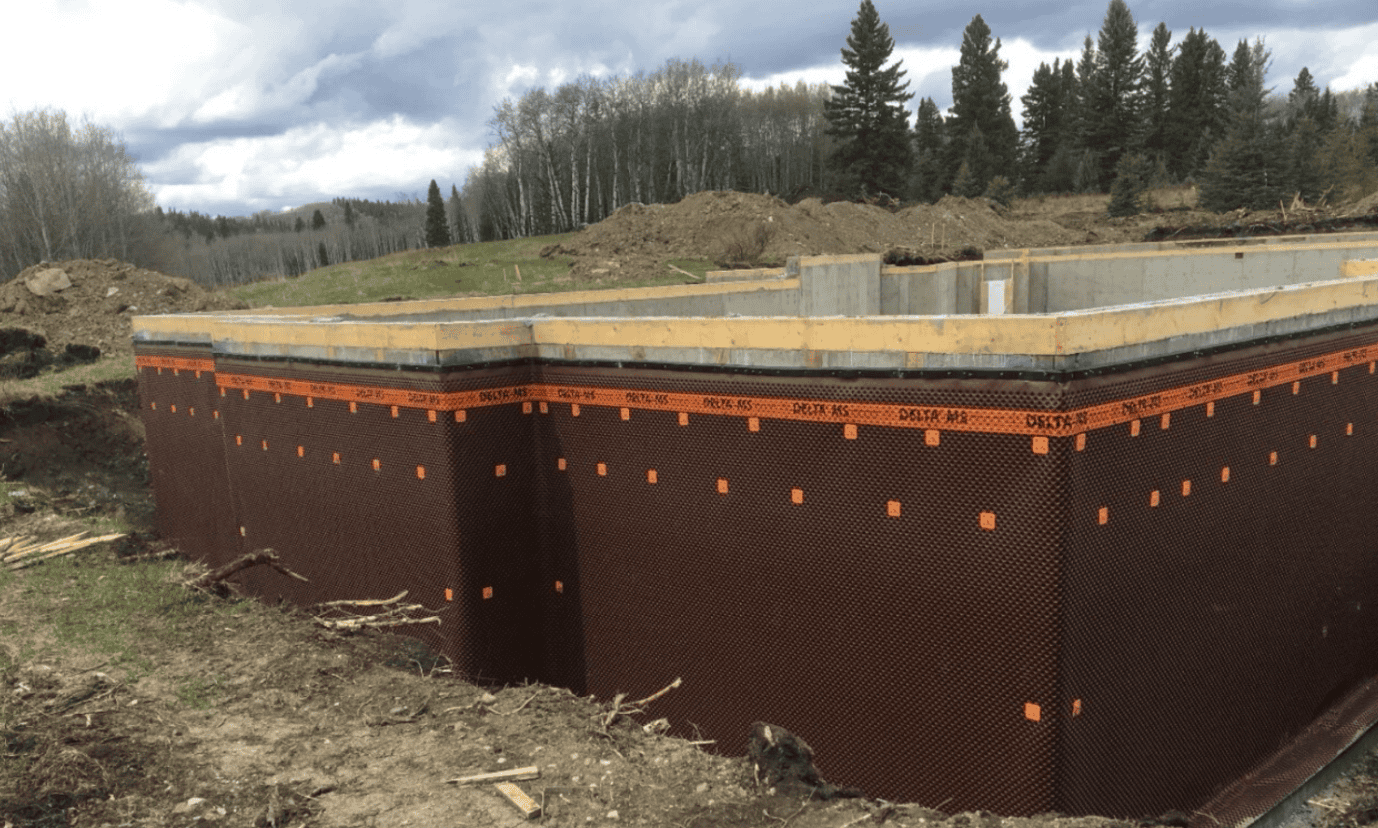
Dimpled HDPE membranes (like DELTA®-MS) are mechanically fastened sheets with a dimpled profile that creates an air gap between the membrane and the foundation wall. That air gap does two things a coating can't: it relieves hydrostatic pressure by giving water a path to drain, and it bridges cracks that form as the foundation settles — a coating simply can't do this once it's cured. DELTA-MS also installs immediately after form removal, with no cure time, which matters on a construction schedule.
Fluid-applied coatings (asphalt, tar-based) are cheaper up front but have real limitations: they require cure time before backfill, can't bridge new cracks, and don't manage hydrostatic pressure the way an air-gap membrane does.
For taller foundation walls or higher hydrostatic loads, DELTA®-TERRAXX is built for vertical foundation applications where pressure resistance is the priority.
For Contractors & Builders: DELTA-MS carries a Red List Free Declare label and is available in multiple roll widths for different wall heights — see the full below-grade moisture barrier catalog for roll-minimum pricing on bulk orders.
Pillar 2: Drainage — Getting Water Away From the Foundation
A waterproofing membrane without drainage just delays a leak — the water still needs somewhere to go. A complete drainage system includes:
- A drainboard like DELTA®-DRAIN, which channels groundwater down to a perimeter drain instead of letting it pool against the wall. For higher-flow or commercial applications, DELTA®-DRAIN 6000 HI-X is built for heavier-duty foundation drainage.
- Perimeter drain pipes, tied into a sump pump, running the full perimeter of the foundation footing
- Proper site grading — a 2-6% slope away from the foundation for at least the first several feet
- Downspout extensions that discharge well away from the foundation rather than at the base of the wall
Skipping drainage is the single most common reason a "waterproofed" basement still takes on water — the membrane holds, but the water has nowhere to go and eventually finds a weak point.
Pillar 3: Moisture Control — Stopping Capillary Rise and Vapor Intrusion
Even with waterproofing and drainage handled, moisture can still migrate into a foundation through capillary action — water wicking through the microscopic pores in concrete itself, independent of any crack or seam.
DELTA®-FOOTING BARRIER installs as a capillary break between the footing and the foundation wall, stopping this wicking action at the source — something asphalt dampproofing and standard poly sheeting under slabs typically miss. For subfloor applications, DELTA®-FL provides a similar capillary break under finished basement flooring.
This pillar also covers soil gas: a properly detailed dimpled membrane system combined with an airtight, battery-backed sump pit reduces radon and methane infiltration risk — worth flagging explicitly on any project in a known radon zone.
Product Comparison: Which System Fits Your Project
| System | Solves | Recommended Product | Best For |
|---|---|---|---|
| Exterior waterproofing membrane | Water intrusion, crack bridging | DELTA®-MS | New construction, standard foundation walls |
| High hydrostatic pressure walls | Pressure resistance on tall/vertical walls | DELTA®-TERRAXX | Deep basements, retaining walls |
| Foundation drainage | Hydrostatic pressure relief | DELTA®-DRAIN | Residential foundation perimeters |
| Heavy-duty/commercial drainage | High groundwater flow | DELTA®-DRAIN 6000 HI-X | Commercial, parking structures |
| Capillary break | Rising damp at the footing | DELTA®-FOOTING BARRIER | All below-grade foundation types |
| Installation fastening | Secure membrane attachment | DELTA®-PLUG | Any DELTA-MS/TERRAXX install |
New Construction vs. Retrofit: Two Different Playbooks
New construction gives you access to the exterior wall before backfill — the ideal time to install a full membrane, drainage, and capillary-break system in one pass, since re-excavating later is far more expensive than doing it right the first time.
Retrofitting an existing leaky basement without excavation is still viable: an interior perimeter drain tied to an airtight, battery-backed sump pit, combined with a vapor-tight interior drainage mat, manages water, air, and soil gas without digging up the exterior. This is the same approach used in large-scale infrastructure and tunnel waterproofing, scaled down for residential and light-commercial basements.
Common Mistakes That Undo a Waterproofing Job
- Relying on spray-on coatings alone — no crack-bridging, no drainage, and often requires cure time that delays the schedule
- Skipping the capillary break — moisture wicks in through the footing even with a perfect wall membrane
- Poor grading or short downspouts — undoes drainage work by directing water right back at the foundation
- Ignoring soil gas — an airtight sump lid and proper venting are cheap insurance against radon issues later
Build It Right the First Time
A dry basement isn't one product — it's three systems working together: waterproofing, drainage, and moisture control. Spycor Building Products stocks the complete DELTA® system for every layer of that build, with roll pricing and bulk quantities built for contractors and builders.
Shop Below-Grade Moisture Barriers →
Need help specifying a system for a specific project? Contact our team for a quote.
Frequently Asked Questions
What is the best way to waterproof a basement?
The most effective approach combines an exterior dimpled membrane to stop water intrusion, a drainage system to relieve hydrostatic pressure, and a capillary break to prevent rising damp — not any single product alone.
What is the difference between a dimpled membrane and a fluid-applied coating? Dimpled membranes install immediately with no cure time and bridge cracks as the foundation settles; fluid-applied coatings must cure before backfill and can't bridge new cracks once set.
How much does basement waterproofing cost per square foot?
Material costs vary by product and roll size — view current pricing on the below-grade moisture barrier page — with total installed cost depending on excavation and labor. Contact us for a project-specific quote.
Can you waterproof a basement from the inside?
Yes — an interior perimeter drain and sump system with a vapor-tight drainage mat is a proven retrofit approach when exterior excavation isn't practical.
Do I need both a vapor barrier and a drainage membrane?
Yes — below grade, you need a drainage plane and a capillary/vapor break covering two different failure modes; one product rarely does both jobs well.
What causes a basement to stay wet even after waterproofing?
Usually improper grading, a disconnected perimeter drain, a missing capillary break, or a product not rated for continuous hydrostatic pressure. A site inspection isolates which one applies.