Posted by Spycor LLC on Jun 9th 2026
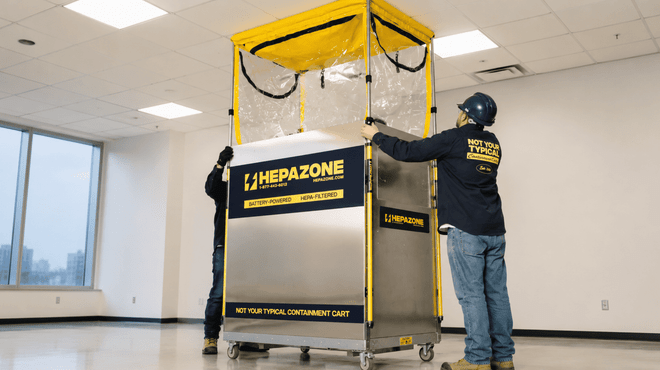
When asbestos fibers, mold spores, or silica dust become airborne on a job site, the window to contain them is measured in seconds — not minutes. A portable HEPA work enclosure is the front-line solution that transforms any wall or ceiling work area into a sealed negative pressure zone, stopping hazardous particles before they migrate into occupied spaces.
But not every enclosure is built for every job. Frame material, filtration type, whether the unit runs on battery or cord, and how it connects to your existing equipment are all decisions that directly affect both worker safety and regulatory compliance. This guide walks through what matters, what the standards require, and which Qualitair HEPAZone models available at Spycor Environmental are best suited to each scenario.
What Is a Portable HEPA Work Enclosure?
A portable HEPA work enclosure — sometimes called a negative pressure work enclosure, dust containment cart, or abatement containment booth — is a collapsible, wheeled enclosure designed to isolate a localized work area during inspection, maintenance, renovation, abatement, or decontamination tasks.
The enclosure surrounds the work zone and, when paired with a HEPA-filtered fan filter unit (FFU) or negative air machine, draws contaminated air through a certified HEPA filter before exhausting clean air back into the environment. This creates negative pressure inside the enclosure, meaning air flows in through gaps rather than out — ensuring that asbestos fibers, mold spores, lead dust, silica particles, and other hazardous contaminants cannot escape into the surrounding area.
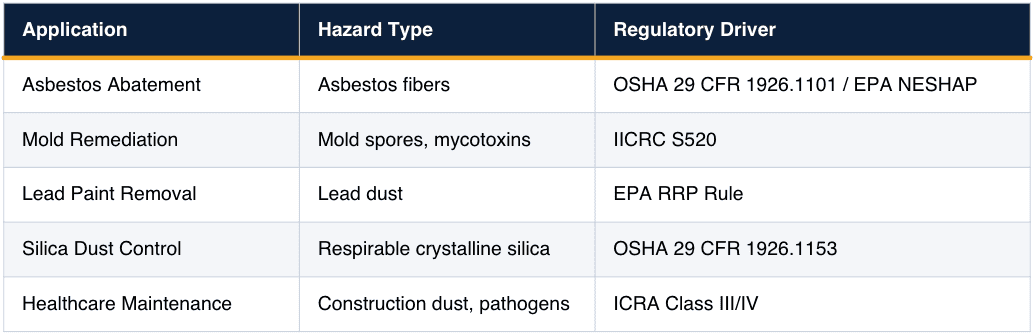
Primary Use Cases
Why Battery Power Changes Everything
Traditional corded negative air machines and portable air scrubbers require a power source within reach — and that limitation is more consequential than it sounds. On a typical abatement job, the cord runs across the floor of the enclosure, creating trip hazards for workers on step ladders inside the unit, and requiring the cord to penetrate the containment barrier in a way that must be carefully sealed to maintain negative pressure.
Battery-powered enclosures eliminate this problem entirely. The Qualitair HEPAZone lineup integrates a battery-powered HEPA fan filter unit (FFU) directly into the enclosure base, delivering:
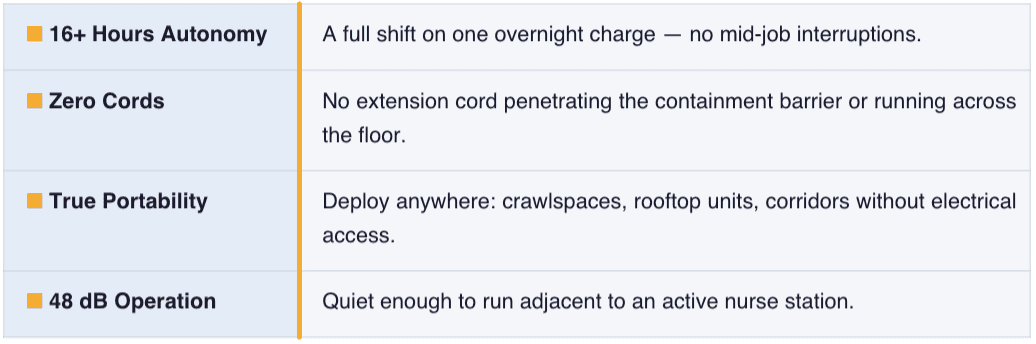
This battery-first design is not a convenience feature. In many real-world environments — occupied hospitals, schools, multi-family residential buildings, and historic structures — the absence of a dangling power cord is a meaningful safety and compliance differentiator.
Key Features to Evaluate Before Buying
1. HEPA Filter Certification Grade
Not all HEPA filters are equal. For regulated abatement work, the minimum standard is a True HEPA filter rated at 99.97% efficiency at 0.3 microns (the MPPS — Most Penetrating Particle Size). For asbestos work specifically, many contractors and safety officers prefer a 99.99% certified filter, which provides a full order-of-magnitude improvement in particle retention at the critical size range.
All Qualitair HEPAZone models include a 99.99% certified HEPA filter, exceeding the baseline requirement and suitable for even the highest-risk applications.
2. Airflow Capacity (CFM) and Air Change Rate
The core performance metric of any containment enclosure is air changes per hour (ACH) — how many times per hour the entire air volume inside the enclosure is filtered. OSHA and EPA abatement guidance generally requires a minimum of 4 air changes per hour inside a containment zone; IICRC S520 for mold remediation recommends a minimum of 6.
The integrated HepaNomad FFU in all HEPAZone units delivers 300 CFM (145 L/s), producing over 150 air changes per hour inside the enclosure — far exceeding regulatory minimums and ensuring a consistently clean breathing environment for the worker inside.
3. Frame Material: Vinyl vs. Metal
Frame construction determines durability, weight, and suitability for different job types.
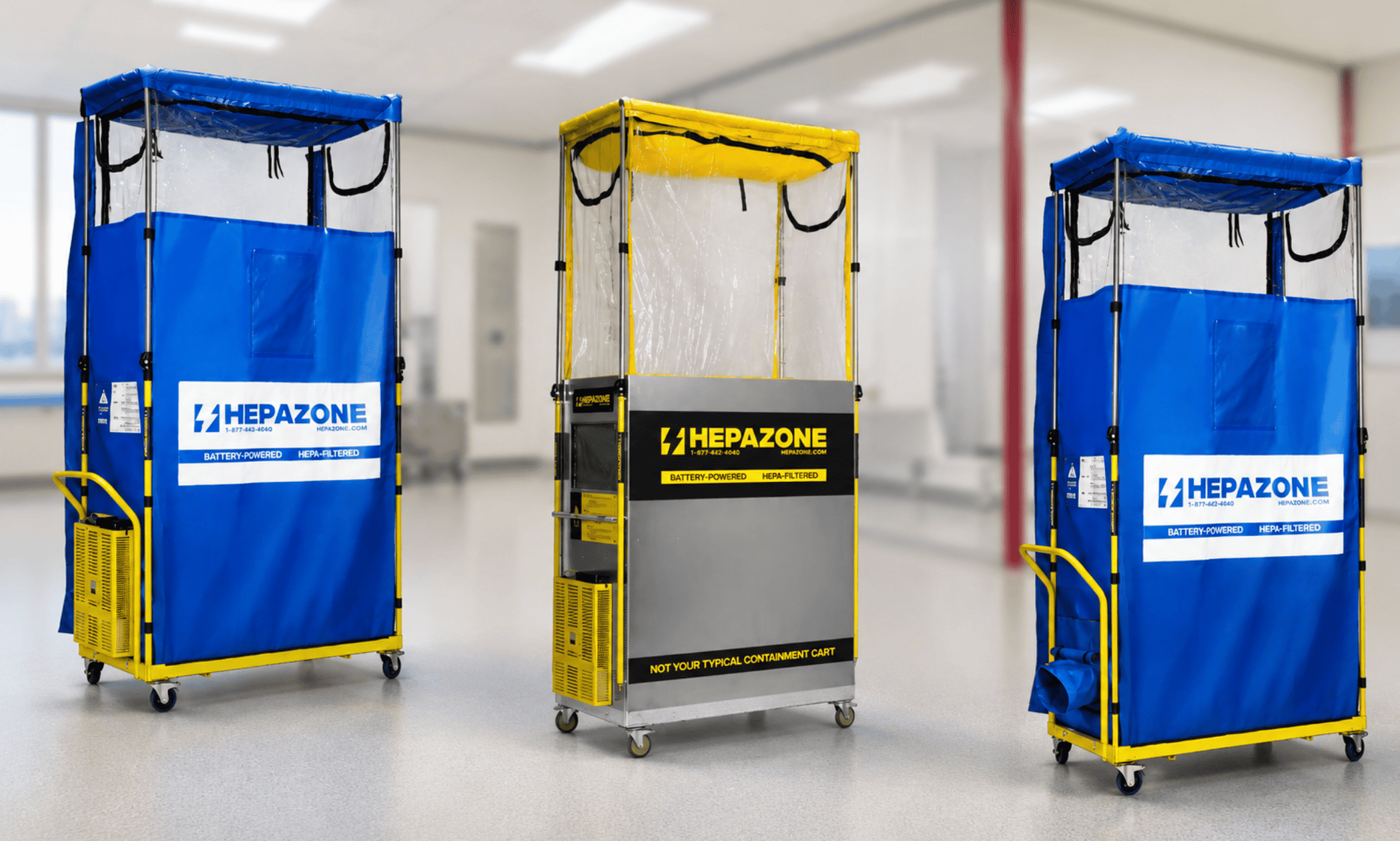
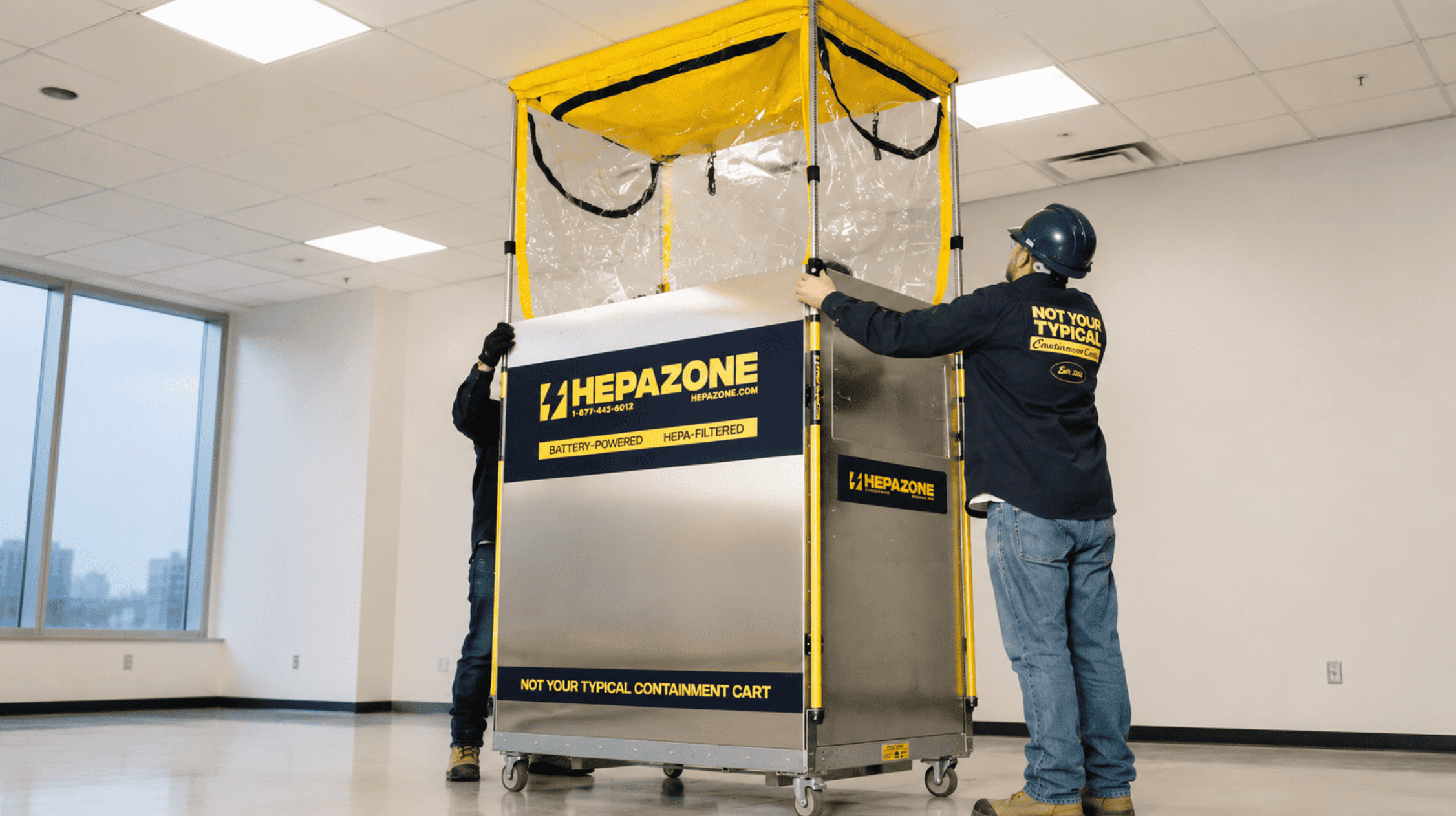
Aluminum-framed vinyl cabin enclosures (HZ-01 and HZ-01S) are lighter, faster to deploy, and easier to transport in a van or service vehicle. The collapsible powder-coated aluminum frame with ratcheting poles and heavy-duty steel latches provides sufficient rigidity for standard abatement work — asbestos pipe and tile removal, mold containment, and ceiling plenum access.
Metal-framed enclosures (HZ-M2) are designed for high-frequency, high-demand environments where the unit is in continuous daily use. The heavier metal construction adds durability for contractors running multiple shifts, environments with rough handling, or facilities that need a unit that will hold up to years of use without frame degradation.
4. Fan-Included vs. Fan-Optional (noFan Shell)
If your operation already owns a quality negative air machine or portable air scrubber, purchasing a fan-optional enclosure shell — rather than a complete battery-powered unit — can reduce capital cost while still providing the containment structure.
The HZ-01S noFan enclosure is designed precisely for this scenario: it features all the structural elements of the HEPAZone platform (ratcheting poles, anti-skid floor, evacuation drain, 25" top access ports) but ships without the integrated FFU. It can be connected to any external negative air machine to create a fully compliant negative pressure workspace.
5. Flame-Resistant Enclosure Material
Any containment enclosure used in a healthcare facility, school, or commercial building with a fire occupancy code must use NFPA 701-compliant flame-resistant materials. Standard polyethylene sheeting fails this requirement. Qualitair HEPAZone enclosures use a self-extinguishing vinyl fabric that meets flame-resistance standards — a non-negotiable requirement for hospital and school contractors.
6. Access Configuration
Ceiling and wall access jobs require the enclosure to seal against the work surface above while allowing the worker to operate safely inside. HEPAZone units feature:
- Full wall and ceiling openings — both wide walls and the cabin top open fully to access wall or ceiling work surfaces
- 25" top access ports — for passing pipes, conduit, or large rigid items through the top of the enclosure without breaking containment
- Clear vinyl windows on all four sides — ambient light penetrates the enclosure, improving worker visibility without requiring interior lighting in most conditions
- Ratcheting telescoping poles — adjust to ceiling heights up to 120" standard, with extension kits available to 168"
The Qualitair HEPAZone Lineup: Which Model for Which Job
Qualitair HEPAZone HZ-01 — Battery-Powered Vinyl Cabin
Best for: Asbestos abatement contractors, mold remediators, and healthcare facility maintenance teams needing a complete, self-contained cordless containment unit for wall and ceiling access work.
The HZ-01 is the flagship all-in-one solution. The integrated battery-powered HepaNomad FFU delivers 300 CFM through a 99.99% certified HEPA filter, the vinyl cabin seals against walls and ceilings using exclusive ratcheting poles, and the entire unit rolls on lockable swivel casters for rapid repositioning between job areas. With a 16-hour battery runtime, a single charge covers a full shift without interruption.
Ideal environments: hospitals, schools, multi-unit residential, and any occupied building where electrical access is limited or extension cords create safety or compliance issues.
Shop the Qualitair HEPAZone HZ-01 at Spycor Environmental →
Qualitair HEPAZone HZ-01S — noFan Work Enclosure
Best for: Contractors who already own negative air machines and need the containment structure without duplicating filtration equipment.
The HZ-01S delivers the complete HEPAZone containment platform — anti-skid floor, evacuation drain, ratcheting poles, full-opening walls and ceiling, clear vinyl windows — in a fan-optional configuration. Connect any HEPA negative air machine to the enclosure port to establish negative pressure. This is the most cost-effective entry point into the HEPAZone system for teams with existing equipment.
Shop the Qualitair HEPAZone HZ-01S noFan at Spycor Environmental →
Qualitair HEPAZone-M HZ-M2 — Battery-Powered Metal Frame
Best for: High-frequency use operations, institutional facility departments, and contractors requiring maximum durability from a unit that deploys daily.
The HZ-M2 delivers the same integrated 300 CFM battery-powered HEPA filtration as the HZ-01, upgraded to a heavy-duty metal frame construction that withstands continuous high-cycle deployment. For facility management teams at large hospitals, universities, or commercial property groups running abatement and maintenance work on a daily basis, the metal frame pays for itself in reduced maintenance and longer service life.
Shop the Qualitair HEPAZone-M HZ-M2 at Spycor Environmental →
The Bottom Line
Choosing a portable HEPA work enclosure comes down to three questions: Does it establish reliable negative pressure? Does it fit the physical demands of your job sites? And does it meet the regulatory standard your work is subject to?
The Qualitair HEPAZone lineup answers all three. The battery-powered HZ-01 and HZ-01M offer unmatched cordless autonomy for occupied buildings and remote job areas. The noFan HZ-01S provides a cost-effective containment structure for teams with existing filtration equipment. And all three are built to the 99.99% HEPA filtration standard that asbestos, mold, and hazardous dust work demands.
All three models are in stock and available at Spycor Environmental — the distributor with over 15 years of experience supplying containment, filtration, and abatement equipment to contractors and facility teams across North America.
Browse the full Qualitair HEPAZone collection at Spycor Environmental:
Compliance Standards These Enclosures Support
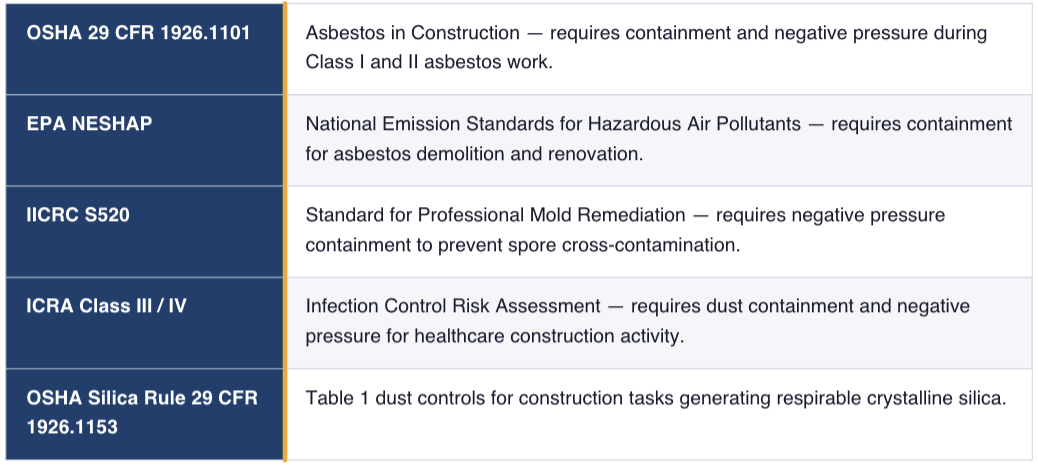
A properly deployed HEPAZone enclosure — with a verified 99.99% HEPA filter, confirmed negative pressure, and an airtight seal against the work surface — supports compliance with:
Frequently Asked Questions
What is the difference between a portable HEPA work enclosure and a standard negative air machine?
A negative air machine is a standalone filtration device that exhausts HEPA-filtered air. A portable HEPA work enclosure is a physical containment structure that surrounds the work area. The HEPAZone integrates both — the enclosure and the filtration — into a single deployable unit.
How long does the HEPAZone battery last on a single charge?
All battery-powered HEPAZone models include the HepaNomad FFU, which provides over 16 hours of autonomous battery operation. The unit can also run on standard 120V power when an outlet is available.
Can the HEPAZone be used for mold remediation?
Yes. The HEPAZone is specifically designed for use in asbestos, mold, silica, and other hazardous dust containment scenarios. The 99.99% HEPA filter captures mold spores well within the required efficiency range.
What ceiling height does the HEPAZone accommodate?
Standard models adjust to a maximum height of 120" (10 feet). An optional extension kit raises maximum height to 168" (14 feet), accommodating most commercial ceiling heights.
Does the noFan HZ-01S work with any negative air machine?
Yes. The HZ-01S shell connects to any external HEPA negative air machine via a standard duct port. It is compatible with most major NAM brands, including those carried by Spycor Environmental.