
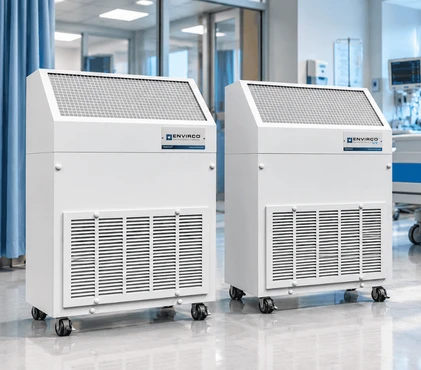
Posted by Spycor LLC on Oct 15th 2026
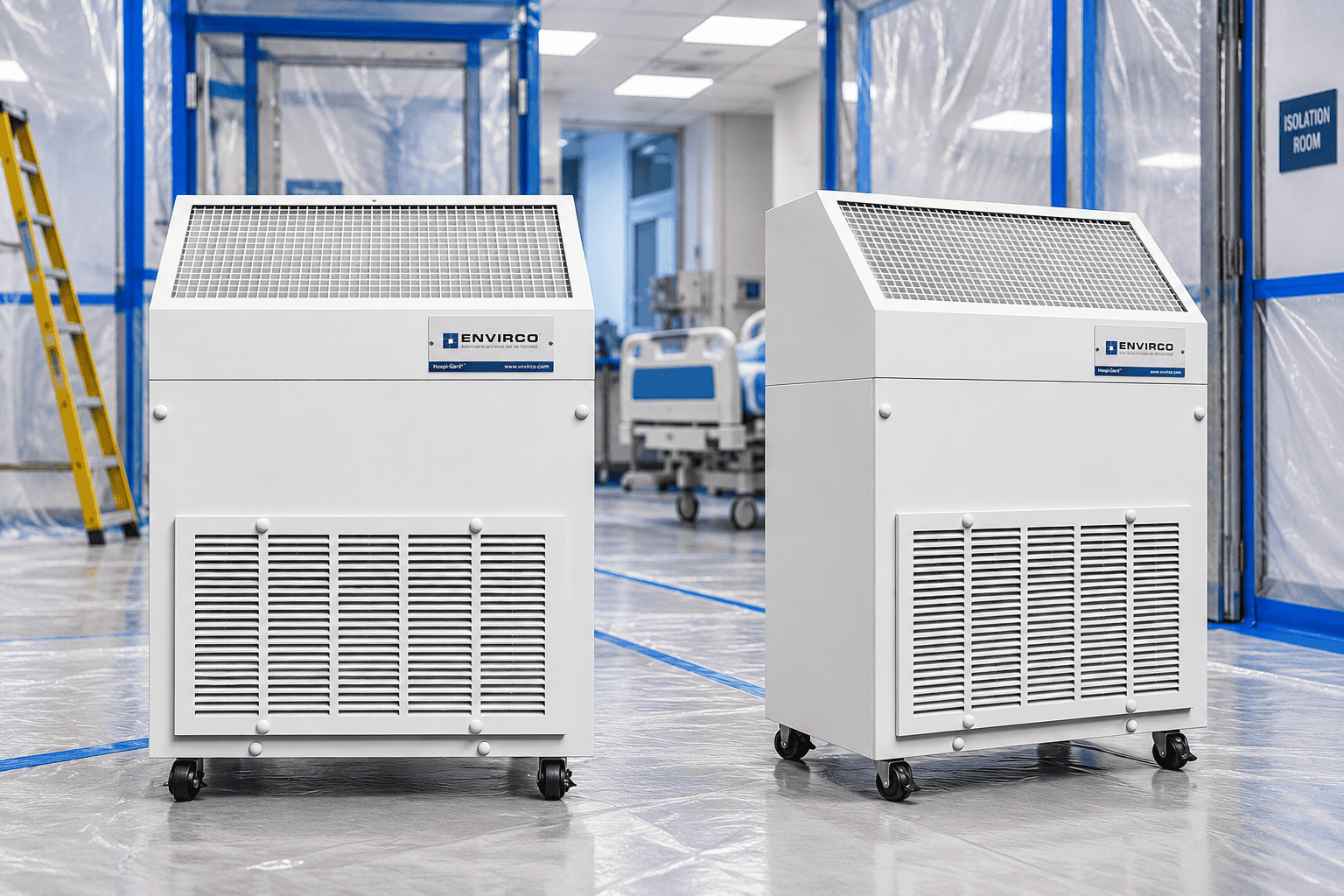
The Envirco Hospi-Gard IsoClean 400 and IsoClean 400UV are the same portable HEPA unit: up to 400 CFM, a 99.99% @ 0.3 micron aluminum-frame HEPA filter, and three operating modes (100% recirculation, 100% exhaust for negative pressure, and partial exhaust). The only difference is that the 400UV adds a UV-C lamp as a supplemental disinfection layer. Choose the IsoClean 400 for negative pressure isolation rooms and construction-adjacent patient rooms. Choose the IsoClean 400UV when the unit will mainly recirculate air in occupied spaces such as waiting rooms, clinics, and modular triage units.
IsoClean 400 vs 400UV: Side-by-Side Specs
Specification |
IsoClean 400 |
IsoClean 400UV |
|---|---|---|
| Spycor SKU | T10950-001 | T10950-005 |
| Max airflow | Up to 400 CFM, variable speed | Up to 400 CFM, variable speed |
| HEPA filter | 99.99% @ 0.3 micron, aluminum frame | 99.99% @ 0.3 micron, aluminum frame |
| Prefilter | Yes, front-accessible | Yes, front-accessible |
| Operating modes | 100% recirculation, 100% exhaust, partial exhaust | 100% recirculation, 100% exhaust, partial exhaust |
| Negative pressure capable | Yes, with exhaust ducting | Yes, with exhaust ducting |
| UV-C lamp | No | Yes |
| Power | 120V | 120V |
| Cabinet | Welded steel, freestanding, made in USA | Welded steel, freestanding, made in USA |
| Air pattern | Low intake, high-velocity top discharge | Low intake, high-velocity top discharge |
| Rated coverage | More than 6 air changes/hour in a 500 sq. ft. space | More than 6 air changes/hour in a 500 sq. ft. space |
How to Set Up the IsoClean 400 for Negative Pressure
Envirco designed the IsoClean line as a low-cost way to create a negative pressure isolation room in an existing space, in line with OSHA and CDC TB guidance. Both models set up the same way:
- Place the unit inside the room you need to isolate, close to the patient or contamination source.
- Connect flexible exhaust ducting to the collar on top of the unit, and vent it outside through a window or wall panel. Confirm collar size for your model in the Envirco installation manual.
- Select the mode. Use 100% exhaust for maximum negative pressure, or partial exhaust to hold negative pressure while recirculating part of the HEPA-filtered air back into the room.
- Seal the room. Keep doors closed and seal major gaps so the exhausted airflow exceeds the air leaking in.
- Verify and monitor. CDC guidance for airborne infection isolation calls for at least 0.01 in. w.c. (2.5 Pa) of negative pressure relative to the corridor. Confirm it with a room pressure monitor instead of assuming.
In 100% recirculation mode, neither model creates negative pressure. It works as a HEPA air cleaner.
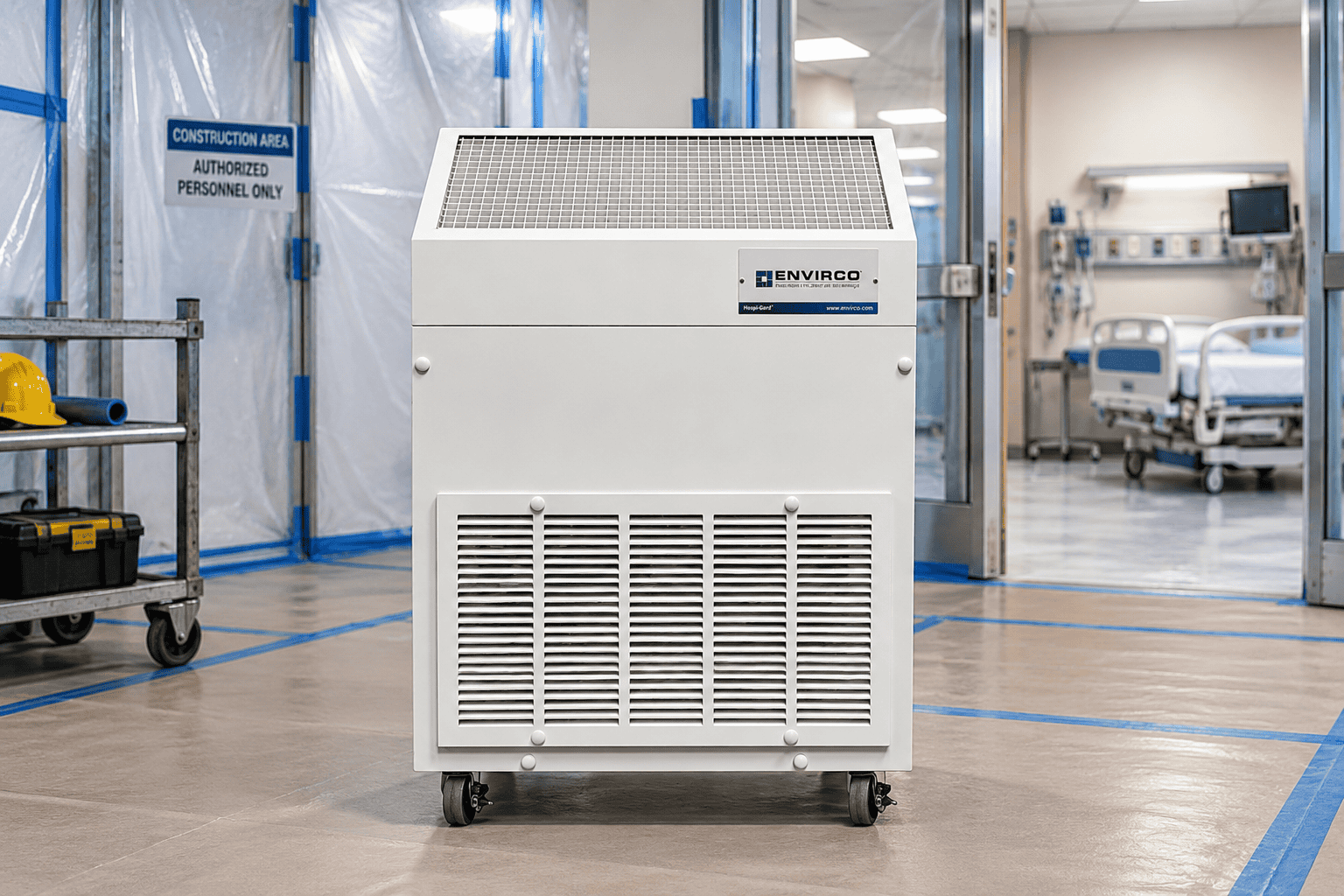
How Many Units Do You Need? Room Sizing Table
Air changes per hour (ACH) = CFM × 60 ÷ room volume (cu. ft.). The figures below assume the unit's full 400 CFM. Actual airflow drops as filters load and when ducting is attached, so size with margin.
Room volume |
Example space |
ACH with 1 unit |
ACH with 2 units |
|---|---|---|---|
| 800 cu. ft. | 10' × 10' room, 8' ceiling | 30 | 60 |
| 1,152 cu. ft. | 12' × 12' patient room, 8' ceiling | 20.8 | 41.6 |
| 1,440 cu. ft. | 12' × 15' exam room, 8' ceiling | 16.7 | 33.3 |
| 1,800 cu. ft. | 15' × 15' room, 8' ceiling | 13.3 | 26.7 |
| 3,200 cu. ft. | 20' × 20' modular or temporary medical unit, 8' ceiling | 7.5 | 15 |
| 4,000 cu. ft. | 500 sq. ft. space, 8' ceiling | 6 | 12 |
CDC guidance calls for at least 12 ACH in new or renovated airborne infection isolation rooms. One IsoClean 400 covers a standard single patient room. A 20' × 20' modular unit used for isolation needs two. For other room sizes, use Spycor.com's Air Flow Calculator. For larger rooms, step up to the 800 CFM Envirco IsoClean HEPA Filtration System.
Which Model Should You Buy?
Buyer / application |
Recommended model |
Why |
|---|---|---|
| Hospital systems creating surge isolation rooms | IsoClean 400 | Air is exhausted outside, so HEPA plus negative pressure does the containment work |
| Hospital renovation and ICRA contractors protecting patient rooms next to the work zone | IsoClean 400 | Simpler to deploy and move between rooms. For the work zone itself, use higher-CFM negative air machines |
| Healthcare HVAC and mechanical contractors specifying temporary negative pressure | IsoClean 400 | Same airflow and modes, without UV lamp maintenance |
| Modular and temporary medical facility builders and rental providers | IsoClean 400UV for recirculating units; IsoClean 400 for isolation units | Triage, exam, and waiting units mostly recirculate, where the UV-C layer adds value |
| Clinics, waiting rooms, and medical or dental offices | IsoClean 400UV | Runs in recirculation mode with an added disinfection layer |
Bottom line: both units share the same HEPA performance and negative pressure capability.
Buy the Envirco IsoClean 400 when the job is isolation and containment.
Buy the Envirco IsoClean 400UV when the unit will mostly recirculate air in occupied patient-care spaces. Ordering for multiple rooms or sites?
Contact Spycor.com for volume quotes and lead times.
Frequently Asked Questions
Is the Envirco IsoClean 400 a negative air machine?
It is a portable HEPA air cleaner that is negative-pressure capable. In 100% exhaust or partial exhaust mode with ducting vented outside, it puts a room under negative pressure. In recirculation mode, it filters and returns air to the room.
What is the difference between the IsoClean 400 and 400UV?
The 400UV adds a UV-C lamp. Airflow, HEPA filter, operating modes, and cabinet are the same.
Does UV-C replace HEPA filtration?
No. The 99.99% HEPA filter is the primary particle control in both models. UV-C is a supplemental layer.
How many IsoClean 400 units does an isolation room need?
One unit provides about 20 ACH in a 12' × 12' room with an 8' ceiling, which exceeds the CDC minimum of 12 ACH for new isolation rooms. Larger rooms or 20' × 20' modular units need two.
Can the IsoClean 400 be used in modular or temporary medical facilities?
Yes. It is freestanding, runs on 120V, fits small floor spaces, and can exhaust through a wall or window, which suits modular clinics, triage units, and temporary structures.